
Decision-Making Styles: Are You a Thinker or a Feeler?
You've been offered two jobs. One pays 30% more but requires relocating away from your closest friends. The other keeps you rooted in your community but with a lower ceiling. How do you decide?
If your instinct is to open a spreadsheet and weigh the variables — cost of living, career trajectory, market trends — you're leaning toward a thinking-dominant decision style. If your first response is a gut feeling about which life feels right, which choice aligns with your values and the people you care about, you're leaning toward a feeling-dominant style.
But here's what most personality content gets wrong: this isn't a binary. It's a spectrum, and where you fall on it shifts depending on context, stakes, and stress.
Beyond Myers-Briggs: what the research actually says
The Thinking-Feeling dimension was popularized by the Myers-Briggs Type Indicator, but the underlying concept has much deeper roots in psychology. Carl Jung originally described it as two rational functions — different but equally valid ways of evaluating information and arriving at judgments.
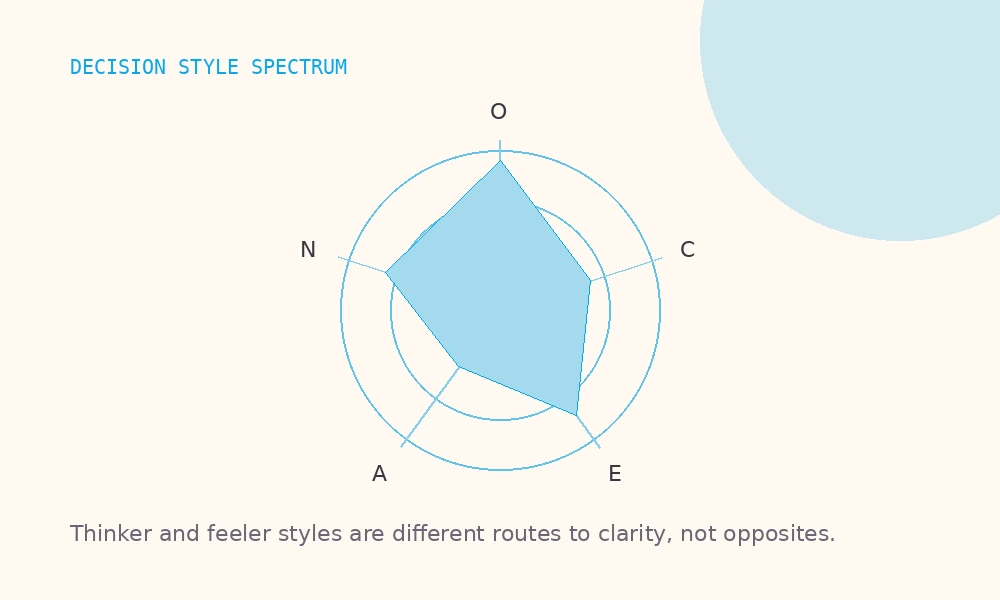
Modern personality science, particularly the Big Five framework, maps this dimension most closely to a combination of Agreeableness and aspects of Openness. People who score lower in agreeableness and higher in certain openness facets tend toward analytical, logic-first reasoning. People higher in agreeableness and emotional sensitivity tend toward values-driven, people-centered evaluation.
The distinction isn't between being rational and being irrational. Both thinking and feeling are rational processes — they just optimize for different outcomes. One optimizes for logical consistency, the other for human impact.
The key insight from decades of research: neither approach is inherently superior. Each produces better outcomes in different situations.
How thinking-dominant decision-making shows up
Thinking-dominant decision-makers prioritize logical analysis, consistency, and objective criteria. They tend to:
- Detach from the immediate emotional context to evaluate options more abstractly. This doesn't mean they don't feel — it means they consciously set feelings aside during the evaluation phase.
- Look for principles and rules that can be applied consistently. If the policy says X, they're inclined to follow it, even when the specific case feels like it deserves an exception.
- Prioritize fairness as equal treatment. Everyone gets the same standard applied to them, regardless of circumstances.
- Feel most confident when they can justify a decision logically — when the reasoning chain is clear and defensible.
In careers, thinking-dominant styles gravitate toward fields where analytical rigor is rewarded: engineering, finance, law, data science. They're often the ones who ask "but what does the data say?" in meetings where everyone else is running on intuition.
The shadow side: thinking-dominant decision-makers can overlook the human cost of technically correct decisions. They may struggle to understand why a "logical" restructuring devastated team morale, or why their partner feels dismissed when they respond to an emotional concern with a solution instead of empathy.
How feeling-dominant decision-making shows up
Feeling-dominant decision-makers prioritize values alignment, relational harmony, and human impact. They tend to:
- Lead with empathy and values. Before asking "what's the most efficient option?" they ask "what's the right thing to do for the people involved?"
- Consider individual circumstances. The same policy might need to be applied differently depending on someone's situation — and that feels like fairness, not inconsistency.
- Weigh the relational consequences of a decision as heavily as the practical ones. A choice that damages trust isn't a good choice, even if the numbers work out.
- Feel most confident when a decision aligns with their core values — when it feels authentic and considers everyone affected.
In careers, feeling-dominant styles excel in roles requiring interpersonal sensitivity: counseling, teaching, human resources, healthcare, design. They're the ones who sense the mood in a room before anyone's said a word.
The shadow side: feeling-dominant decision-makers can struggle with choices where the compassionate option and the effective option diverge. They may avoid necessary confrontations, delay difficult decisions that will hurt someone, or take on others' emotional burdens at the expense of their own well-being.
Context is everything
Here's where it gets interesting. Research shows that most people don't use a single decision style consistently. Instead, they have a default mode — the one they fall back on under pressure — and the capacity to engage the other mode deliberately.
A surgeon might be intensely analytical in the operating room but lead with feeling when deciding whether to recommend a risky procedure to a patient's family. A social worker might be deeply empathetic with clients but switch to thinking mode when allocating a limited budget across programs.
The most effective decision-makers aren't pure thinkers or pure feelers. They're people who know their default, recognize when the situation calls for the other mode, and can make the shift intentionally.
This is where self-awareness becomes transformative. When you know your default decision-making style, you can catch yourself before it leads you astray in the wrong context.
The interaction with other personality traits
Your decision-making style doesn't operate in isolation. It interacts with your other personality dimensions in ways that matter:
High conscientiousness + thinking-dominant: You build rigorous systems and processes. The risk is over-optimization — spending too long analyzing when a good-enough decision now beats a perfect decision later.
High openness + feeling-dominant: You're creative and deeply attuned to meaning and values. The risk is decision paralysis from seeing too many perspectives and caring about all of them equally.
High neuroticism + either style: Stress amplifies your default. Thinkers become hyper-analytical and rigid. Feelers become overwhelmed by emotional input. Understanding this pattern is the first step to managing it effectively.
Practical strategies for better decisions
Rather than trying to change your default style, the goal is to build flexibility:
If you're thinking-dominant:
- Before finalizing a decision, deliberately ask: "Who will this affect, and how will they experience it?" Force yourself to sit with the answer for at least five minutes before moving on.
- Practice naming emotions in the decision context — yours and others'. Not to change the decision, but to inform how you communicate and implement it.
- Recognize when you're using logic to avoid an uncomfortable feeling. Sometimes the "rational" analysis is just a sophisticated avoidance mechanism.
If you're feeling-dominant:
- Before committing to a values-driven choice, write down the practical tradeoffs. Not to override your instincts, but to make sure you're choosing consciously rather than reflexively.
- Practice separating "this feels wrong" from "this is wrong." Discomfort isn't always a signal — sometimes it's just the friction of a necessary change.
- Build in a waiting period for major decisions. Your initial emotional response may shift once you've had time to process.
Knowing your pattern changes the game
The real power of understanding your decision-making style isn't about self-improvement — it's about self-knowledge. When you know you default to thinking, you can deliberately seek out a feeling-dominant perspective before making a big call. When you know you default to feeling, you can build in analytical checkpoints.
And when you can articulate your style clearly, you unlock something else: the ability to communicate it to the people and AI tools you work with. An AI that knows you're thinking-dominant can present options with data and tradeoff matrices. One that knows you're feeling-dominant can frame the same information through the lens of values and human impact.
Your decision-making style isn't a flaw to fix. It's a pattern to understand, a default to be aware of, and a strength to deploy in the right context.
Curious where you fall on the thinking-feeling spectrum? Take the free decision-making quest and turn that pattern into context your AI tools can actually use.
Keep reading
The Science Behind InnerForge's Checkpoints
Personality checkpoints built on decades of validated research. How InnerForge makes personality assessment accurate, engaging, and useful.
What Your Big Five Scores Actually Mean
The Big Five is psychology's gold standard — but most people misread their scores. Here's what yours actually predict about how you think and feel.
Why AI Therapy Bots Fall Short
AI therapy bots lack personality awareness and real understanding. Why self-knowledge tools — not replacement therapy — are the ethical path forward.