
Why AI Therapy Bots Fall Short
There's a wave of AI products promising to be your therapist. Some frame it as "emotional support." Others go further — claiming to offer CBT, DBT, or psychodynamic techniques through a chat interface. The pitch is compelling: therapy is expensive, waitlists are long, and an AI is available at 3 AM when you can't sleep and your thoughts are spiraling.
But there's a gap between what these bots promise and what they actually deliver. And that gap has real consequences.
This isn't an argument against AI in mental health. It's an argument for honesty about what AI can and can't do — and a case for why self-knowledge tools are a more ethical, more effective approach than pretending a language model is a therapist.
The imitation problem
Modern AI therapy bots are built on large language models. These models are extraordinarily good at pattern-matching language. They can generate responses that sound therapeutic — reflective listening, validation, open-ended questions, gentle reframes.
But sounding therapeutic and being therapeutic are fundamentally different things.
A skilled therapist doesn't just reflect your words back to you. They track patterns across weeks and months. They notice what you avoid talking about. They hold a dynamic model of your personality, your defenses, your attachment style, your history — and they adjust their approach based on all of it, often in ways they can't even fully articulate.
AI therapy bots don't do this. They respond to what's in front of them — the current message, maybe a few messages of context. They have no persistent model of who you are. Every session, you're essentially a stranger again.
The most dangerous thing about AI therapy bots isn't that they're bad at therapy. It's that they're good enough at sounding like therapy that users mistake the imitation for the real thing.
Personality blindness
Here's a specific failure mode that rarely gets discussed: AI therapy bots are personality-blind.
Consider two people experiencing the same issue — say, procrastination on a major work project. Person A scores high in neuroticism and low in conscientiousness. Person B scores low in neuroticism and high in openness but gets paralyzed by too many interesting options.
A good therapist would recognize that these are fundamentally different problems wearing the same costume. Person A needs emotional regulation strategies and anxiety management. Person B needs constraint-setting and decision frameworks.
An AI therapy bot gives both of them the same response: "It sounds like you're feeling stuck. What do you think might be holding you back?" It's not wrong, exactly. It's just not useful. It's the therapeutic equivalent of a form letter.
This personality blindness extends to communication style too. Some people need direct, no-nonsense feedback to break through avoidance patterns. Others shut down completely when confronted directly and need a gentler approach. AI therapy bots have no mechanism to know which approach fits which person — so they default to one style (usually the soft, validating one) and hope it works.
As we've explored in our breakdown of what Big Five scores actually mean, personality traits aren't just interesting facts about yourself. They determine how you respond to different intervention styles. Ignoring them isn't just suboptimal — in a therapeutic context, it can be counterproductive.
The context collapse
Real therapy is built on continuity. Your therapist remembers that your relationship with deadlines connects to your father's expectations. They know that when you say "I'm fine," you usually aren't. They track the arc of your progress across months.
AI therapy bots experience context collapse. Each conversation is either fully isolated or connected by a thin thread of summarized notes. The nuance — the hesitations, the patterns of avoidance, the slow shifts in language that signal real change — is lost.
Some platforms are working on persistent memory for their bots. But memory and understanding are not the same thing. Storing facts about a user ("has anxiety about work deadlines") is very different from holding a dynamic, adaptive model of their psychological landscape.
The risk of false sufficiency
Perhaps the most concerning issue is what researchers call "false sufficiency" — the feeling that you're getting adequate help when you're not.
When someone talks to an AI therapy bot and feels temporarily better, they may delay seeking real professional help. The bot provided relief in the moment — validation, a calming reframe, a breathing exercise — but it didn't address the underlying patterns. It treated the symptom and left the cause untouched.
For mild stress or everyday frustration, this might be harmless. For clinical depression, anxiety disorders, trauma responses, or personality-driven patterns that run deep, it's not just insufficient — it's a detour away from effective treatment.
The ethical question isn't "can AI provide therapy?" It's "should we build products that let people believe they're receiving therapy when the evidence says otherwise?"
What AI actually does well for mental health
None of this means AI has no role in mental health. It means the role needs to be redefined — away from imitation therapy and toward genuine self-knowledge tools.
Here's what AI is genuinely good at:
Assessment and pattern recognition. AI can process large amounts of self-reported data and identify patterns that might take a human weeks to spot. Structured personality assessments, behavioral pattern tracking, and trait mapping are well within AI's capabilities — and they don't require the AI to pretend it understands you.
Psychoeducation. AI is excellent at explaining psychological concepts, helping people understand frameworks like the Big Five, attachment theory, or cognitive distortions. Education isn't therapy, but it's a powerful enabler of self-awareness.
Personalization infrastructure. Rather than trying to be a therapist, AI can make every other tool in your life more personality-aware. A coach package that captures your traits and communication preferences can improve how AI assistants, productivity tools, and learning platforms interact with you — without pretending to treat clinical conditions.
Preparation for real therapy. One of the biggest barriers to effective therapy is that people don't know themselves well enough to communicate their patterns to a therapist efficiently. Self-knowledge tools can accelerate the early phase of therapy by giving both the client and the therapist a structured starting point.
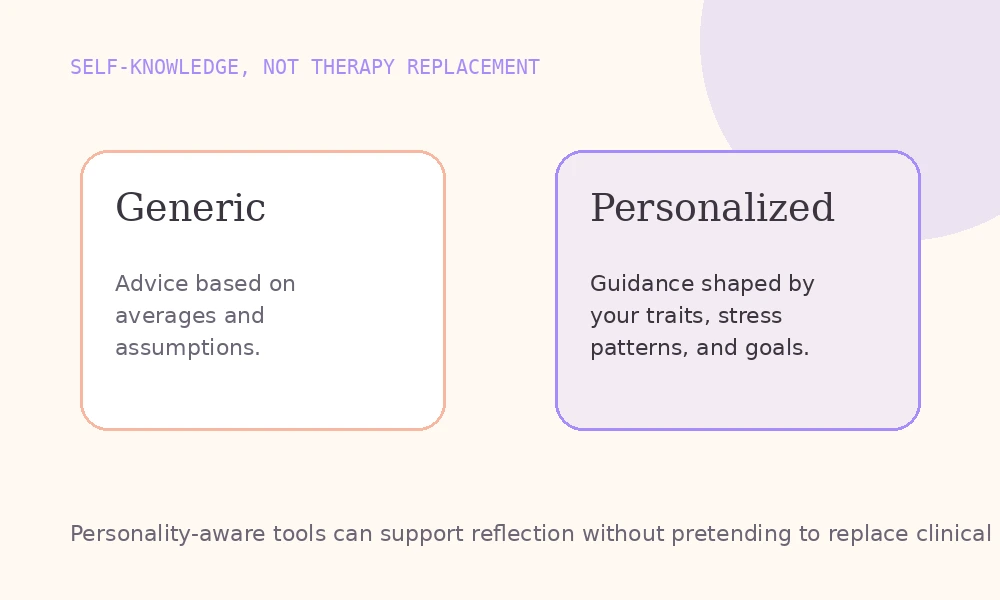
Generic AI
I am sorry you feel that way. Try journaling and breathing exercises.
Personality-aware AI
This is a self-reflection moment, not a therapy substitute. Name the pattern, notice what usually triggers it for you, and decide whether this needs a coach, a trusted person, or clinical support.
The self-knowledge alternative
At InnerForge, we made a deliberate choice: we build self-knowledge tools, not therapy replacements. That is also why our comparison pages separate coaching from clinical care instead of blurring the line — see the BetterHelp alternative, Wysa alternative, and Replika alternative breakdowns for the category boundaries.
Our quests help you understand your personality structure, communication patterns, and cognitive style. We turn that understanding into practical outputs — blueprints you can use to personalize your AI tools, frameworks you can share with a real therapist, and insights that help you recognize your own patterns in daily life.
This isn't therapy. We don't diagnose, treat, or prescribe. We don't pretend a language model can hold the complexity of a therapeutic relationship.
What we do is give you structured self-knowledge — the kind that makes everything else more effective. Better therapy sessions because you can articulate your patterns. Better AI interactions because your tools understand your style. Better self-awareness because you have a vocabulary for what you've always felt but couldn't name.
The ethical line
The mental health space needs AI companies to be honest about what their products can and can't do. That means:
- Don't call it therapy if there's no licensed professional in the loop
- Don't design for dependency — build tools that make users more self-sufficient, not more reliant on the bot
- Don't ignore personality differences — a one-size-fits-all empathy script isn't support, it's a template
- Do build for self-knowledge — help people understand themselves better so they can make informed decisions about their mental health
The future of AI in mental health is bright, but only if we build it on honesty rather than imitation. The most powerful thing AI can do for your mental health isn't pretending to be your therapist. It's helping you understand yourself well enough to get the right help from the right source.
InnerForge builds personality science tools, not therapy replacements. Try the Emotional Companion or take a free quest to see what structured self-knowledge can do for you.
Keep reading
The Problem With One-Size-Fits-All AI
AI trained on average behavior fails real individuals. Why cognitive diversity demands personality-aware AI for advice that actually fits you.
ChatGPT Custom Instructions Template: Copy-Paste (2026)
Copy-paste ChatGPT custom instructions template. Structure personality data and preferences so ChatGPT stops giving generic, unhelpful advice.
Give Claude a Personality: Custom Instructions Guide (2026)
Set up Claude Projects with custom instructions that make Claude understand you. Personality-based templates for better AI conversations.