
How Self-Awareness Transforms Relationships
Think about the last significant conflict you had with someone you care about. Not a trivial disagreement — a real one, the kind that left a mark. Now ask yourself: how much of that conflict was about the actual issue, and how much was about the invisible patterns each of you brought into the room?
If you're honest, it's probably more of the latter than you'd like to admit.
Most relationship problems aren't caused by bad people or incompatible personalities. They're caused by unexamined personalities — people operating on autopilot, running old scripts, reacting to triggers they haven't identified yet. The single most powerful thing you can do for every relationship in your life is to know yourself more clearly.
That's not a soft, feel-good claim. It's backed by decades of research in personality psychology, emotional intelligence, and relationship science.
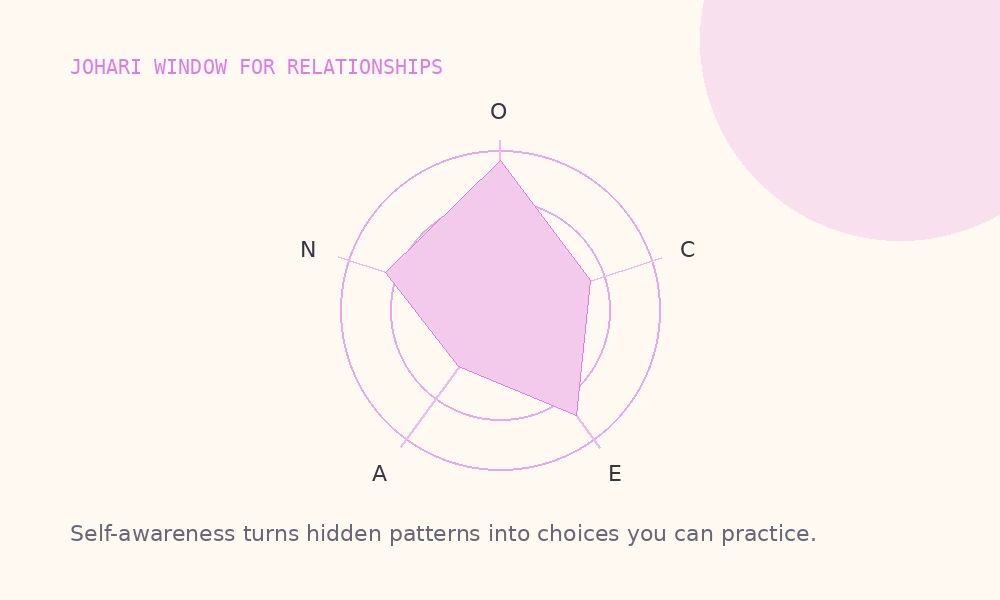
The self-awareness gap
Here's a humbling finding: most people think they're more self-aware than they actually are. Organizational psychologist Tasha Eurich's research found that while 95% of people believe they're self-aware, only about 10-15% actually meet the criteria by objective measures.
The gap exists because self-awareness has two components that people often confuse:
Internal self-awareness: Understanding your own values, emotions, patterns, strengths, and weaknesses. This is what most people think of when they hear "self-awareness."
External self-awareness: Understanding how other people experience you. This is the uncomfortable part — and the part most people skip.
You can be deeply introspective and still have massive blind spots about how your behavior lands on others. The person who says "I'm just being honest" while consistently making people feel small has internal self-awareness about their value of honesty but zero external self-awareness about its impact.
Self-awareness isn't just knowing who you are. It's knowing how who you are affects everyone around you — and caring enough to do something about it.
The Johari Window: mapping what you know and don't know
In 1955, psychologists Joseph Luft and Harrington Ingham created a model called the Johari Window that elegantly maps the self-awareness landscape. It divides self-knowledge into four quadrants:
Open area — things you know about yourself that others also see. Your known personality traits, your acknowledged skills, your visible habits. This is the space where authentic connection happens, because both parties are working with the same information.
Hidden area — things you know about yourself but conceal from others. Your private insecurities, your unspoken motivations, the feelings you edit before expressing them. Everyone has a hidden area, but when it's too large, relationships stay shallow because people are connecting with your performance, not your reality.
Blind spot — things others can see about you that you can't see yourself. This is the quadrant that wrecks relationships. Your blind spots are the patterns that are obvious to everyone except you. The way you shut down during conflict. The subtle condescension when you're explaining something you know well. The tendency to make everything about yourself when someone else is sharing a problem.
Unknown area — things neither you nor others have discovered yet. Latent potential, undiscovered triggers, patterns that only emerge in specific circumstances you haven't encountered.
The goal of self-awareness work is to expand the Open area by shrinking the other three — especially the Blind Spot.
How personality blind spots create conflict
Every personality trait has a shadow side that's most visible to others and least visible to you. Here's how the major dimensions create relational blind spots:
High extraversion blind spot: You dominate conversations without realizing it. You interpret your partner's need for quiet as rejection or disengagement. You process externally, meaning you say things out loud that aren't fully formed — and others take those half-thoughts as commitments or genuine opinions.
Low extraversion blind spot: You withdraw during conflict when your partner needs engagement. Your rich inner world feels complete to you, but to others, your silence reads as indifference or stonewalling. You assume people know what you're thinking because it's so vivid inside your head.
High agreeableness blind spot: You avoid necessary conflict until resentment builds, then explode in ways that shock people. You say yes when you mean no, then blame others for the resulting overcommitment. Your desire to maintain harmony means people never quite know where you actually stand.
Low agreeableness blind spot: You mistake being right for being effective. Your directness, which feels like honesty to you, feels like an attack to others. You underestimate how much your critical feedback costs people emotionally, even when the content is accurate.
High neuroticism blind spot: Your emotional intensity creates an atmosphere of urgency that exhausts others. You interpret your strong reactions as proportional to the situation, while others experience them as disproportionate. You may unconsciously recruit others into managing your emotional state.
High conscientiousness blind spot: Your standards feel like care to you and feel like judgment to others. You "help" by pointing out what could be improved, not realizing that people hear criticism, not support. Your need for order and planning can make partners feel controlled.
These aren't flaws to eliminate — they're tendencies to be aware of. The trait itself is neutral. The blind spot is where the damage happens.
The research linking self-awareness to relationship quality
The evidence is robust. A 2019 study in the Journal of Personality and Social Psychology found that individuals with higher self-awareness reported greater relationship satisfaction, better conflict resolution, and more secure attachment patterns. The effect held across romantic relationships, friendships, and family bonds.
Emotional intelligence research by Daniel Goleman and others consistently identifies self-awareness as the foundational competency. Without it, the other components — self-regulation, empathy, social skill — have nothing accurate to build on. You can't regulate emotions you don't recognize. You can't empathize with others if you're projecting your own unexamined feelings onto them.
Every relationship skill you want to build — communication, empathy, conflict resolution, trust — depends on the accuracy of your self-model. If that model is distorted, everything built on it will be slightly off.
Research on couples by John Gottman's lab at the University of Washington found that partners who can accurately identify their own emotional triggers and communication patterns during conflict have dramatically better outcomes than those who can't. The ability to say "I'm getting defensive right now because this touches on my fear of inadequacy" is more powerful than any communication technique.
Why understanding yourself is the foundation of understanding others
There's a psychological principle called projection — the tendency to attribute your own unacknowledged feelings, traits, and motivations to other people. When your self-knowledge is limited, projection runs unchecked.
The person who hasn't examined their own competitive streak sees competition everywhere in others. The person who hasn't acknowledged their own fear of abandonment interprets a partner's need for space as cruelty. The person who hasn't recognized their own anger experiences it as other people's aggression.
Self-awareness interrupts projection. When you've mapped your own emotional landscape thoroughly, you're far less likely to mistake your internal weather for someone else's behavior. You can see them more clearly because you've cleared the lens.
This is also why personality frameworks are so valuable for relationships — not because they let you type or categorize your partner, but because they give you a shared language for differences that would otherwise just feel like friction. "You're wrong" becomes "we process this differently because of our different personality profiles." That shift changes everything.
Building self-awareness: practical approaches
Self-awareness isn't achieved through a single insight or personality test. It's an ongoing practice. Here are evidence-backed approaches:
Ask for specific feedback — and make it safe
Generic questions like "How am I doing?" generate generic answers. Instead, ask targeted questions: "When we disagree, what do I do that makes it harder to resolve?" or "What's one thing I do that I probably don't realize bothers you?" Then — and this is the hard part — receive the answer without defending yourself.
Keep a pattern journal
Not a diary of events, but a log of reactions. When you have a strong emotional response, write down: what happened, what you felt, what you did, and what you wanted to do. Over weeks, patterns emerge that are invisible in the moment — the situations that consistently trigger you, the defense mechanisms you default to, the stories you tell yourself.
Study your decision-making patterns
How you make decisions reveals your values, your fears, and your cognitive defaults. Do you analyze when you should be feeling? Feel when you should be analyzing? Avoid decisions entirely? Your decision-making style is a window into your personality that's easier to observe than raw emotion.
Use personality assessments as mirrors, not labels
The Big Five, attachment style assessments, values inventories — these are most useful not as identity labels but as starting points for reflection. When a result surprises you, that's where the growth is. The gap between how you see yourself and how a well-validated instrument describes you is precisely your blind spot.
Get a therapist or coach
This is the highest-leverage self-awareness tool available. A skilled therapist provides something no amount of self-reflection can: an external perspective from someone trained to spot the patterns you're too close to see. They are, essentially, a professional expander of your Johari Window's Open area.
Self-awareness isn't self-absorption
There's an important distinction. Self-awareness is about you but for others. The goal isn't to become endlessly self-focused — it's to become accurate enough in your self-understanding that you stop unconsciously burdening your relationships with your unexamined patterns.
The most self-aware people aren't the ones who talk about themselves the most. They're the ones who show up with the clearest picture of what they're bringing into the room — their strengths, their triggers, their defaults, their biases — so they can connect authentically rather than reactively.
That's the transformation. Not becoming a different person, but becoming someone who knows the person they are well enough to choose how to show up, rather than being driven by patterns they've never examined.
Ready to uncover your personality blind spots and build a clearer self-model? InnerForge's personality quests are designed to surface the patterns that matter most — in your relationships, your decisions, and your daily life.
Keep reading
Emotional Intelligence: The Skill Most People Overlook
EQ outpredicts IQ for career, relationships, and mental health. The four-part skill set most people never deliberately build — and how to start.
Understanding Your Attachment Style
The 4 attachment styles — secure, anxious, avoidant, disorganized — how they shape adult relationships and how to shift yours.
Understanding Your Communication Style
Why some conversations click and others clash. The four communication styles, what causes mismatches, and how to find and flex your default.