
Emotional Intelligence: The Skill Most People Overlook
Ask someone what emotional intelligence means and you'll usually hear some version of "being good with people" or "knowing how others feel." That's not wrong, but it's like defining athletic ability as "being good at sports." It tells you nothing about what the skill actually involves or how to build it.
Emotional intelligence — EQ — is one of the most studied constructs in psychology over the past three decades, and the research is clear: it predicts life outcomes that IQ can't touch. Job performance, leadership effectiveness, relationship satisfaction, mental health, even physical health outcomes all correlate more strongly with EQ than with raw cognitive ability.
Yet most people have never spent a single hour deliberately working on it.
What EQ actually is
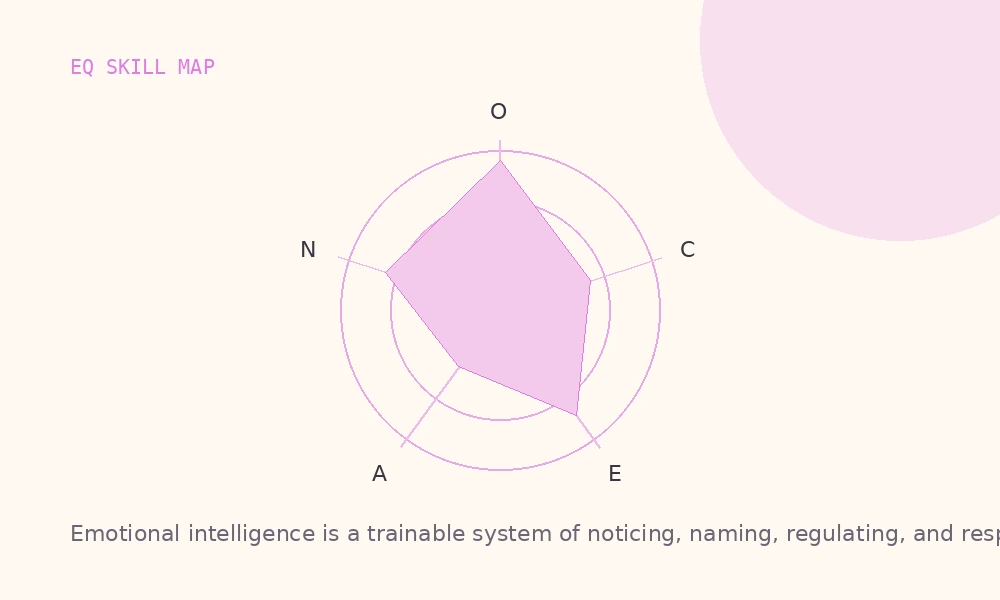
The model that's held up best under scientific scrutiny breaks emotional intelligence into four components. These aren't four flavors of the same thing — they're distinct skills that build on each other.
1. Self-awareness
This is the foundation. Self-awareness is the ability to accurately identify what you're feeling, why you're feeling it, and how it's influencing your behavior in real time.
It sounds simple. It isn't.
Most people operate on a delay. Something happens, they react, and then — maybe hours later — they realize they were angry, not just "fine." Or they notice a pattern: every time their manager gives feedback in a group setting, they shut down. But they don't connect that reaction to an underlying emotional trigger until much later, if at all.
True self-awareness is live, not retrospective. It's the difference between getting swept up in an emotion and watching it arrive.
Self-awareness isn't about controlling your emotions. It's about seeing them clearly enough that they stop controlling you.
2. Self-management
Once you can see your emotions in real time, self-management is what you do with that information. It's the ability to regulate your emotional responses — not suppress them, but choose how to express them.
This shows up in practical ways:
- Pausing before sending the heated email
- Recognizing that your frustration with a colleague is actually anxiety about a deadline, and addressing the real issue
- Maintaining motivation through a boring but important task because you've connected it to a larger goal
- Adapting your energy and tone to match what a situation requires
Self-management is where personality plays a major role. If you score high on neuroticism in the Big Five framework, self-management requires more deliberate effort — not because you're less capable, but because your emotional responses are more intense. Understanding this removes the self-blame and replaces it with strategy.
3. Social awareness
This is the component most people associate with EQ — reading the room, picking up on others' emotions, understanding unspoken dynamics. But it goes deeper than empathy.
Social awareness includes:
- Empathy: Feeling what others feel and understanding their perspective
- Organizational awareness: Reading the power dynamics, cultural norms, and unwritten rules in a group
- Service orientation: Anticipating others' needs before they're articulated
People with high social awareness notice the colleague who goes quiet in meetings, pick up on tension between team members before it becomes conflict, and instinctively know when someone needs space versus support.
This skill has a strong relationship to how you handle stress and resilience. When you're stressed, social awareness is usually the first EQ component to degrade — you become so focused on your own internal state that you lose the bandwidth to track others'.
4. Relationship management
This is where everything comes together. Relationship management is the ability to use your emotional awareness — of both yourself and others — to navigate interactions effectively.
It includes:
- Influence and persuasion (without manipulation)
- Conflict management
- Coaching and mentoring
- Building bonds and teamwork
- Inspiring and catalyzing change
This isn't charm or charisma. It's the disciplined application of emotional information to build and maintain productive relationships. A leader with strong relationship management doesn't just motivate their team — they know which team member needs public recognition, which one needs private acknowledgment, and which one needs to be challenged.
Why EQ outpredicts IQ
The data on this is striking. Research by psychologist Daniel Goleman and others has found that EQ accounts for roughly 58% of performance across all types of jobs. In leadership roles, that number climbs higher. Studies tracking individuals over decades show that EQ measured in early adulthood predicts relationship satisfaction, career advancement, and even health outcomes 20 years later — after controlling for IQ and socioeconomic background.
Why? Because almost everything that matters in life involves other people. Getting hired, getting promoted, maintaining a marriage, parenting effectively, building friendships, resolving conflicts — these are all fundamentally emotional and interpersonal tasks. IQ helps you solve technical problems. EQ helps you navigate the human landscape where those solutions have to be implemented.
In a world that increasingly values collaboration, adaptability, and leadership, emotional intelligence isn't a soft skill. It's the skill.
This doesn't mean IQ is irrelevant. It means that past a certain threshold of cognitive ability, EQ becomes the differentiator. Among equally smart people, the ones with higher EQ consistently outperform.
The personality connection
Your Big Five personality traits create the raw material that EQ is built from. But traits and skills aren't the same thing.
Agreeableness gives you a natural advantage in empathy and social awareness — but without self-management skills, high agreeableness can become people-pleasing.
Extraversion makes relationship management feel more natural — but introverts who develop deliberate EQ skills are often more effective in one-on-one leadership because they listen more deeply.
Conscientiousness supports self-management through discipline — but without self-awareness, it can become rigid perfectionism.
Openness feeds emotional vocabulary and nuanced understanding — but without grounding in social awareness, it can lead to overthinking rather than action.
The point is: your personality sets your starting position. EQ is the skill set you build from there. Two people with identical Big Five profiles can have radically different emotional intelligence depending on whether they've intentionally developed these four components.
Building EQ deliberately
Unlike IQ, emotional intelligence is highly trainable at any age. Here's where to start with each component:
Self-awareness: Keep a brief emotional log for two weeks. Three times a day, note what you're feeling and what triggered it. Patterns will emerge faster than you expect.
Self-management: Practice the six-second pause. When you feel a strong emotional reaction, count to six before responding. This engages your prefrontal cortex and interrupts the amygdala's impulse to react.
Social awareness: In your next three conversations, focus entirely on the other person. Don't plan your response while they're talking. Just listen and observe. Notice their tone, body language, and what they're not saying.
Relationship management: Choose one relationship that has friction. Apply what you've learned — identify the emotional dynamics at play, adjust your communication style, and track what changes.
EQ isn't a destination
Emotional intelligence isn't something you achieve and then have forever. It's a practice — a set of skills that sharpen with use and dull with neglect. The most emotionally intelligent people aren't the ones who never struggle with emotions. They're the ones who've built systems for noticing, processing, and responding to emotions effectively.
The first step is always the same: see your own patterns clearly. Everything else builds from there.
Take the free EQ assessment — it maps your strengths across all four components and shows you exactly where targeted growth will have the biggest impact on your life.
Keep reading
How Self-Awareness Transforms Relationships
Self-awareness transforms every relationship. The Johari Window, personality blind spots, and why knowing yourself is step one to knowing others.
Why AI Therapy Bots Fall Short
AI therapy bots lack personality awareness and real understanding. Why self-knowledge tools — not replacement therapy — are the ethical path forward.
Growth Mindset vs Fixed Mindset: What Research Says
Growth mindset isn't just belief — it's how you relate to difficulty. The research Carol Dweck actually did, and how to cultivate it.