
Free Personality Test That Matters in the AI Age
You've taken a personality test before. Maybe multiple. You know your MBTI type, your Enneagram number, your "color," your love language. You shared the result, recognized yourself in the description, and moved on.
And absolutely nothing changed.
That's not a knock on you. That's the design problem with almost every free personality test on the internet. They're built to be shareable, not useful. They give you a label when what you actually need is a tool.
The personality test you took gave you a label. Then what?
Here's how the standard free personality test experience goes:
You click through 60 questions. You get a four-letter acronym or a dramatic archetype name. You read the description — "yes, that's so me" — and screenshot it. Maybe you send it to a friend. Maybe you use it to explain yourself in conversation: "I'm an INFJ, so I need a lot of alone time."
And then the result lives in your head as a vague story you tell about yourself, with zero impact on your actual decisions, habits, or relationships.
The problem isn't that the label is wrong. The problem is that a label is a dead end. It doesn't tell you what to do. It doesn't help you make better decisions this week. It doesn't change how you interact with the tools and systems you use every day.
Personality science has never been more valuable — and personality tests have never been less useful. That gap is exactly what InnerForge was built to close.
What actually makes a personality test useful?
Not all tests are created equal. Most free personality tests fail on at least one of three criteria that separate real tools from fun quizzes.
Scientific validity. Does the framework actually measure stable, real-world-relevant traits? Or is it built on intuition and marketing? A scientifically valid test produces consistent results across time and conditions, and its scores predict things that matter — job performance, relationship patterns, stress responses, learning preferences.
Actionable output. Does the result tell you something you can do? Not just "you're introverted" — but what that means for how you structure your day, how you need to communicate in meetings, what kinds of decisions drain you vs. energize you. The insight has to connect to behavior or it's just self-description.
Integration into your daily life. This is where every existing personality platform drops the ball. Even the scientifically solid ones give you a PDF report you read once and never open again. For a personality profile to actually change anything, it needs to show up where you already spend your time. In the tools you use. In the conversations you have. In the advice you receive.
Most free personality tests nail none of these. A handful nail the first one. Almost nobody has solved the third.
Why psychologists trust the Big Five — and you should too
Before we get to what InnerForge does differently, it's worth understanding why the underlying science matters.
You've heard of MBTI (the Myers-Briggs Type Indicator). Maybe the Enneagram. These frameworks have devoted followings and pop-culture staying power. They're also not what psychologists actually use.
The framework personality researchers trust is the Big Five — also called OCEAN, for its five dimensions: Openness to experience, Conscientiousness, Extraversion, Agreeableness, and Neuroticism.
The reasons are concrete:
It replicates. The Big Five structure has been found independently across dozens of languages, cultures, and research teams. When you run factor analysis on personality data from Japan, Brazil, Germany, or the United States, you get the same five dimensions. MBTI and Enneagram don't show this kind of cross-cultural consistency.
It predicts. Big Five scores have demonstrated predictive validity across real-world outcomes — academic performance, job success, relationship satisfaction, health behaviors, longevity. These aren't trivial correlations. A conscientiousness score predicts job performance better than most interview processes. Neuroticism scores predict health outcomes across decades.
It uses continuous dimensions, not boxes. MBTI forces you into one of 16 types. The Big Five gives you a position on five spectrums — a precise location in personality space, not a category to be sorted into. That precision matters enormously when you're trying to use your profile for anything practical.
It's stable. Your Big Five profile is remarkably consistent across time and context. What you measure today will largely match what you measure in six months. That makes it useful as a long-term reference — not a snapshot of your current mood.
This is the foundation InnerForge builds on. Not because it's trendy — because it works.
The InnerForge checkpoint: a free personality test that produces something real
InnerForge's psychological assessments are called checkpoints, and the distinction from a standard test is intentional. Traditional assessments are clinical slogs — 200 Likert-scale items rating how much you agree with abstract statements. Checkpoints are scenario-based, shorter, and designed to surface your personality through the choices you naturally make.
The Big Five checkpoint takes about 5 minutes and is completely free. You'll encounter situations that mirror real decisions, and your patterns emerge from how you respond — not from how you describe yourself, which is notoriously unreliable. (People consistently overestimate their conscientiousness and underestimate their neuroticism when self-rating on abstract scales.)
Behind the design, the scoring is serious. Your responses are mapped to continuous scores on each Big Five dimension using psychometric algorithms. You get a position on a spectrum — not a label. Your individual trait scores are analyzed in combination, because the interaction between traits is where your real behavioral patterns live. And your scores are contextualized against population norms, so you understand what "high" and "low" actually mean relative to other people.
The experience is fast. The science underneath is not. That's the balance InnerForge is designed to strike.
What you get after the checkpoint
This is where InnerForge parts ways with every other free personality test.
You don't get a label. You get real data and a real path to using it.
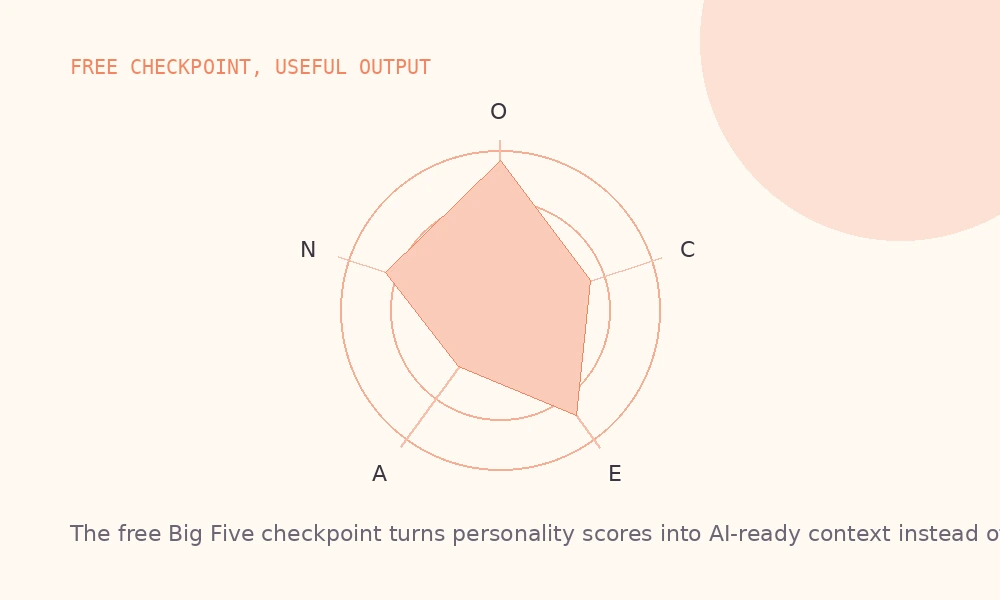
Your Big Five scores, for free. Five continuous dimensions with percentile context. A visual radar chart of your profile. Written interpretations of what your specific combination means — not copy-pasted trait definitions, but how your pattern actually plays out.
Insights calibrated to your specific combination. High openness with low conscientiousness produces different patterns than high openness with high conscientiousness. The interpretations you see reflect your actual profile, not a generic bucket.
A clear path to a coach package. This is where InnerForge diverges from every "free personality test" you've taken. Your free scores are the intake for ten specialized AI coaches — Emotional Companion, Career, Relationships, Money, Habits, and more. When you're ready, generating a coach package turns your raw scores into two artifacts designed for AI: coach instructions (a system prompt tuned to your profile) and a personality file (structured data the AI reads as knowledge). Paste them into Claude Projects, ChatGPT Projects, or Gemini Gems, and every conversation after that is calibrated to your actual personality. Not to the average person.
There is no paid gate. The scores are yours, the coaches are free, and the coach package is there when you want to turn that data into something your AI actually uses.
The real value: personality data that works for you every day
Here's the difference between InnerForge and every other free personality test you've taken.
With every other test, the result exists in your head. Maybe it informs how you think about yourself occasionally. Maybe it comes up in a personality-test conversation at a party. But it doesn't actually affect your daily experience in a measurable way.
With InnerForge, once you've generated a coach package, your personality file lives inside your AI tools. Every time you open ChatGPT's project for help with a work decision, it knows you're high in openness and naturally generate too many options before committing — so it helps you narrow, not expand. Every time you ask Claude for feedback on something you wrote, it knows you prefer directness over diplomatic softening — so it actually tells you what's wrong. Every time you use Gemini to think through a relationship issue, it knows you process emotionally before logically — so it doesn't push you toward immediate rational conclusions.
That's not a one-time quiz result. That's your personality working for you in real time, every day, across every AI conversation you have.
The result of most personality tests compounds to approximately zero over time. The result of an InnerForge checkpoint — and the coach you build from it — compounds with every AI interaction after it. That's a different kind of value entirely.
The goal was never to know your personality type. The goal was to actually use that knowledge for something.
Most free personality tests stop at the knowing. InnerForge starts there.
Take the free checkpoint. It's 5 minutes. You'll get your real Big Five scores, and if you choose a coach afterward, the generated package actually changes how your AI talks to you. Pick a free coach and start.
Keep reading
ChatGPT Custom Instructions Template: Copy-Paste (2026)
Copy-paste ChatGPT custom instructions template. Structure personality data and preferences so ChatGPT stops giving generic, unhelpful advice.
Give Claude a Personality: Custom Instructions Guide (2026)
Set up Claude Projects with custom instructions that make Claude understand you. Personality-based templates for better AI conversations.
Give Gemini a Personality: Gems Setup Guide (2026)
Make Google Gemini actually useful with Gems — custom AI agents that know how you think. Step-by-step setup guide with personality-based instructions.