
How Personality Data Makes AI Actually Useful
You've probably had this experience: you ask an AI for advice, get a perfectly reasonable answer, and feel absolutely nothing. No insight. No "aha" moment. Just competent, forgettable text that could have been written for anyone.
Now imagine the AI knew that you score in the 85th percentile for openness, 30th percentile for conscientiousness, and 75th percentile for neuroticism. Imagine it knew your top values are autonomy and creativity, and your emotional intelligence profile shows strong empathy but weak self-regulation.
The advice it gives you with that context isn't just different. It's useful. Here's why.
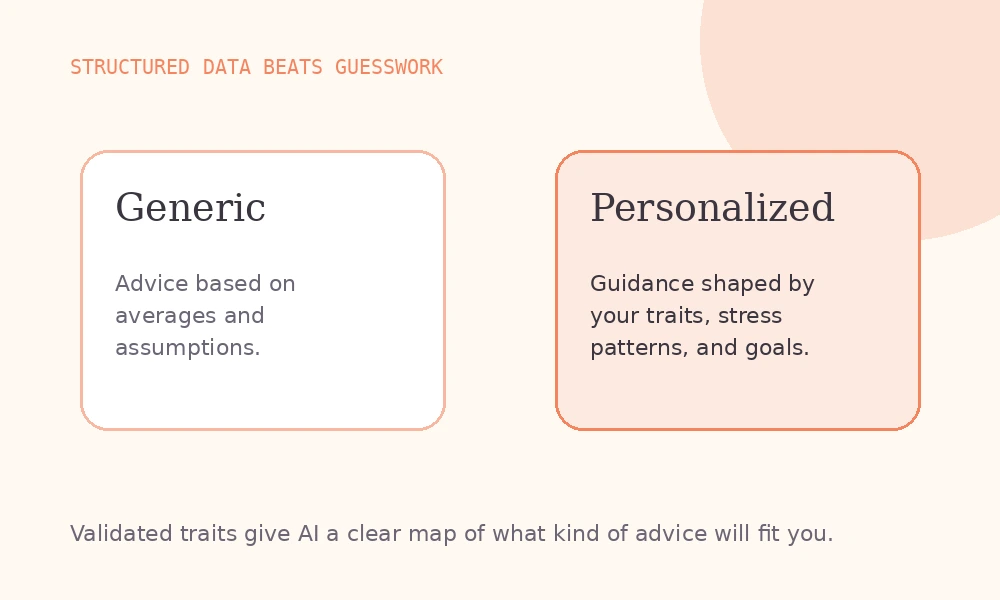
The bridge between psychology and AI
Personality science and AI have been developing in parallel for decades, but they've barely intersected. Psychologists have built rigorous, validated frameworks for understanding human individual differences. AI researchers have built increasingly capable language models. Neither field has seriously addressed what happens when you combine them.
The combination is powerful because each solves the other's core limitation:
-
Psychology's limitation: Personality science can describe your patterns, but it can't sit with you at 11pm when you're struggling with a decision. It can't generate personalized strategies in real time. It scales through human practitioners, which is slow and expensive.
-
AI's limitation: Language models can generate advice instantly on any topic, but they know nothing about the specific person they're advising. They optimize for the average, which serves no one perfectly.
When you feed structured personality data into an AI, you get a system that has the responsiveness and breadth of AI with the individual specificity of a good psychologist. Not a replacement for therapy — but a dramatic upgrade from the generic AI experience.
What counts as "structured personality data"
Not all self-knowledge is equally useful for AI. Telling a model "I'm kind of introverted and I like to plan ahead" is vague, subjective, and hard for the system to operationalize. Structured personality data is different:
Big Five scores provide the foundational layer. Five continuous dimensions — Openness, Conscientiousness, Extraversion, Agreeableness, Neuroticism — that predict behavior across virtually every life domain. When an AI knows you score at the 25th percentile in agreeableness, it can calibrate its advice differently than for someone at the 90th percentile. (Not sure what your scores mean? Here's what your Big Five scores actually tell you.)
Emotional intelligence profiles add the affective layer. How well do you recognize emotions in others? How effectively do you regulate your own emotional states? These scores predict how you handle stress, conflict, relationships, and decision-making under pressure.
Values hierarchies provide the motivational layer. Do you prioritize security or adventure? Achievement or harmony? Independence or belonging? Values predict which goals feel meaningful and which advice feels irrelevant.
Cognitive style indicators round out the picture. Are you a sequential or holistic thinker? Do you prefer concrete examples or abstract principles? This determines not just what advice works but how it should be delivered.
The difference between raw self-knowledge and structured personality data is the difference between a bag of ingredients and a recipe. Both contain the same information. Only one is immediately actionable.
Before and after: real examples
Let's look at what happens when the same AI prompt gets answered with and without structured personality data. These examples use real profile archetypes.
Prompt: "How should I approach a major career change?"
Without personality data: "Research your target industry thoroughly. Network with professionals in the field. Update your resume to highlight transferable skills. Consider taking courses to fill knowledge gaps. Set a timeline and milestones for your transition."
With personality data (High openness, low conscientiousness, high neuroticism, moderate extraversion): "Your natural curiosity is an asset here — you'll explore options more thoroughly than most people. But watch out for two patterns your profile suggests: first, you may keep researching endlessly instead of committing to a direction. Set a hard deadline for your exploration phase — two weeks, max — then pick your top option and start taking concrete steps. Second, your emotional sensitivity means this transition will feel bigger and scarier than it objectively is. That's normal for your profile, not a sign you're making the wrong choice. Build in regular check-ins with someone you trust who can help you distinguish real concerns from anxiety noise."
The second response isn't just longer. It anticipates specific failure modes, addresses the person's actual emotional experience, and provides strategies calibrated to their cognitive style.
Prompt: "Help me give better feedback to my team."
Without personality data: "Be specific and timely with feedback. Focus on behaviors, not character. Balance positive and constructive feedback. Create a psychologically safe environment for open dialogue."
With personality data (Low agreeableness, high conscientiousness, low neuroticism, low openness): "Your strength is that you see problems clearly and aren't afraid to name them. Your blind spot is that your directness can feel like an attack to teammates with different profiles. You don't need to learn to be 'nicer' — that would feel inauthentic and your team would see through it. Instead: lead with the specific impact of the problem ('This is costing us two hours per sprint'), give your assessment directly, then explicitly invite their perspective on the fix. Your low neuroticism means you recover from tough conversations quickly — but your team members may not. Follow up the next day to reset the relationship. Don't assume silence means agreement."
Again: same prompt, radically different utility. The second response works with the person's traits rather than asking them to pretend they're someone else.
Prompt: "I keep procrastinating on important tasks."
Without personality data: "Break tasks into smaller steps. Use time-blocking. Remove distractions. Set rewards for completed work. Try accountability partners."
With personality data (High openness, high extraversion, low conscientiousness, moderate neuroticism): "Standard anti-procrastination advice probably hasn't worked for you because it's designed for people who already have some natural structure. Your profile suggests you procrastinate because routine tasks don't provide enough stimulation — your brain literally needs more novelty and social energy to engage. Try these instead: work in public spaces or on video calls with friends (body doubling leverages your extraversion), change your physical environment every 90 minutes, gamify tasks with visible progress markers, and accept that you'll do your best work in bursts, not steady marathons. Stop trying to build 'discipline' as a general trait. Instead, build specific rituals around your three highest-priority tasks only."
Why a coach package outperforms raw data
You might wonder: why not just paste your Big Five scores into a chat and call it a day? You can — and it helps. But a rendered coach package works better than raw scores for several reasons.
A coach package includes interpretation. A score of 72 on conscientiousness means nothing to an AI without context. A coach package translates that into behavioral patterns: "Tends to create detailed plans but may over-optimize at the expense of action. Responds well to structured frameworks. Procrastinates only on ambiguous tasks."
A coach package connects traits. Your openness score in isolation tells a partial story. Your openness combined with your conscientiousness and neuroticism tells the whole story. The coach package maps these interactions explicitly.
A coach package is AI-readable. It's structured in a format that language models parse efficiently — no ambiguity, no interpretation needed. The AI spends its tokens generating useful responses instead of trying to figure out what your self-description means.
Instructions and data do different jobs. Coach instructions tell the AI how to talk to you — voice, tone, what to avoid. The personality file tells the AI who you are — scores, patterns, reflections. Splitting them lets each one be sized and structured for its job rather than crammed into a single paragraph.
This is the approach InnerForge takes: short psychological checkpoints produce scores, scores generate a two-artifact coach package (instructions + personality file), and the package plugs directly into Claude Projects, ChatGPT Projects, or Gemini Gems.
The compound effect
Here's what most people miss about personality-aware AI: the value compounds. Every AI interaction becomes a little more useful, which means you use AI more effectively, which means you accomplish more, which generates new questions to bring to your AI — now with the same deep context every time.
Over weeks and months, the gap between someone using generic AI and someone using personality-calibrated AI becomes enormous. It's the difference between having a vague acquaintance who gives you platitudes and having a trusted advisor who knows your patterns.
Getting started
You don't need to wait for AI platforms to build personality features. The power of structured self-knowledge is that it's portable. Once you generate a free coach package, you can paste it into any AI system — ChatGPT, Claude, Gemini, or any custom agent.
The process is straightforward:
- Pick a coach that maps to what you actually want AI help with
- Take a short psychological checkpoint (about five minutes, validated instruments)
- Generate the coach package to render the two artifacts — coach instructions and personality file
- Paste the instructions into your AI's project/Gem field and upload the personality file as a knowledge file
The result: every AI in your life suddenly knows who it's talking to. And the advice gets specific, relevant, and genuinely useful — often for the first time.
Ready to see the difference? Browse InnerForge's free coaches and pick the one that fits what you're working on. Each one renders a coach package that transforms any AI conversation from generic to genuinely yours.
Keep reading
From Checkpoint to Coach: How Psychology Becomes AI Context
How InnerForge works end-to-end — pick a coach, take a checkpoint, paste the prompt into ChatGPT, Claude, or Gemini. Psychology meets AI.
Paste Your Personality Into ChatGPT, Claude & Gemini
A step-by-step guide to giving ChatGPT, Claude, or Gemini real context about who you are. Two artifacts, a few minutes of setup, same AI you already pay for.
ChatGPT Custom Instructions Template: Copy-Paste (2026)
Copy-paste ChatGPT custom instructions template. Structure personality data and preferences so ChatGPT stops giving generic, unhelpful advice.