
The Problem With One-Size-Fits-All AI
There's a quiet assumption baked into every major AI product: that one interaction model can serve all humans equally well. The same tone, the same advice structure, the same level of directness, the same motivational framing — for billions of people with wildly different brains.
This assumption is failing. And the people it fails the most are the ones who need AI the most.
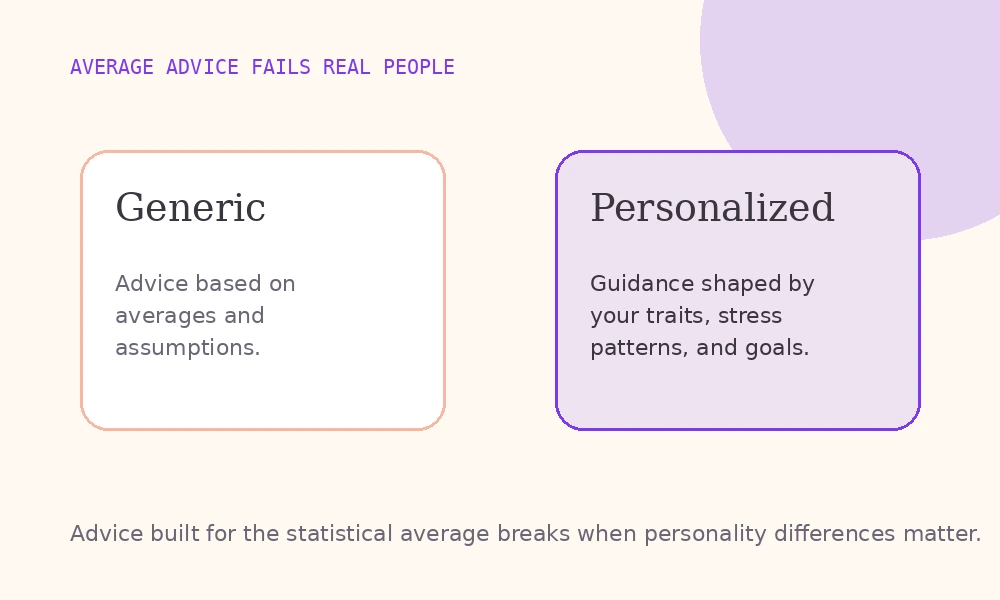
Trained on the average, optimized for no one
Large language models learn from massive datasets of human text. Through this training, they absorb a kind of composite personality — the "average" communication style, the most common advice patterns, the typical way humans explain things to each other.
The result is an AI that sounds reasonable to most people but resonates deeply with almost no one. It's like a suit cut to fit the statistical average body. The proportions are "right" on paper, but it hangs wrong on every actual person who puts it on.
This isn't a theoretical problem. Research in differential psychology has shown for decades that humans vary dramatically in how they process information, respond to feedback, make decisions, and manage their emotions. The Big Five personality dimensions alone account for massive variance in how people approach virtually every cognitive task.
When AI ignores this variance, the advice it gives is correct in the abstract but wrong in the specific. And specifics are where advice actually matters.
Telling a highly neurotic person to "just relax and trust the process" is like telling someone with a broken leg to "just walk it off." The advice isn't wrong in theory. It's wrong for that person.
The diversity of human cognition
Let's make this concrete. Here are five real personality profiles and how one-size-fits-all AI fails each of them:
The analytical introvert (high conscientiousness, low extraversion, high openness). When they ask AI for career advice, they get told to "network more" and "put yourself out there." What they actually need: strategies for building meaningful professional relationships through written communication and small-group settings — approaches that leverage their natural depth rather than fighting against it.
The impulsive creative (high openness, low conscientiousness, high extraversion). Standard productivity advice about systems, routines, and habits doesn't just fail to help — it actively discourages them. What they need: high-stimulation work structures, novelty-based motivation, and accountability that feels like collaboration, not surveillance.
The anxious perfectionist (high neuroticism, high conscientiousness, low openness). They ask for help with decision-making and get "weigh the pros and cons." They've already done that seventeen times. What they need: permission frameworks, time-boxing techniques, and explicit acknowledgment that their thoroughness is a strength that needs a boundary, not a weakness to overcome.
The conflict-avoidant empathizer (high agreeableness, high neuroticism, low extraversion). They ask for help with a workplace issue and get "address it directly." For them, directness without preparation triggers overwhelming anxiety. What they need: scripted approaches, role-playing, and reassurance that setting boundaries isn't the same as being aggressive.
The independent skeptic (low agreeableness, low neuroticism, high conscientiousness). They ask for team collaboration advice and get platitudes about "building trust" and "listening more." What they actually need: frameworks for structured disagreement, strategies for channeling their critical thinking without alienating colleagues, and acknowledgment that their skepticism often prevents team mistakes.
Five people. Five completely different optimal approaches. And generic AI gives all of them the same response.
Why this matters more than you think
You might think this is a minor inconvenience — AI gives slightly suboptimal advice, so what? But the downstream effects compound.
In productivity, following advice that conflicts with your natural cognitive style creates friction. You spend willpower fighting your own brain instead of getting work done. Studies show that personality-matched work strategies outperform generic strategies by significant margins.
In coaching and self-improvement, generic advice breeds discouragement. When the "proven" technique doesn't work for you, the natural conclusion is that something is wrong with you. In reality, the technique simply doesn't match your personality profile.
In mental health, one-size-fits-all approaches can be actively harmful. A strategy that helps someone low in neuroticism manage stress (exposure, leaning in) can overwhelm someone high in neuroticism. Communication approaches that work for extraverts can intensify an introvert's social anxiety.
In relationships, generic communication advice often backfires. "Express your feelings more" isn't useful for someone who already has high emotional expressiveness and low agreeableness — their problem isn't expression, it's calibration.
The AI industry's blind spot
The tech industry has spent enormous resources making AI smarter — larger models, better reasoning, more capabilities. But almost no one is working on making AI aware of who it's talking to.
This is a bizarre oversight. In human interactions, we instinctively adapt our communication to the person in front of us. We speak differently to a child than to a colleague. We adjust our directness based on how the other person handles criticism. We modulate our energy to match the room.
AI does none of this. It has one mode. And that mode is calibrated to an imaginary "average" person who doesn't exist.
The next leap in AI usefulness won't come from bigger models. It will come from models that understand who they're talking to.
Some argue that AI will learn your preferences over time through conversation. This is true to a degree, but it's painfully slow and unreliable. It takes dozens of interactions for an AI to pick up on your communication preferences, and it still misses the deeper personality structures that drive those preferences.
Compare that to what happens when you give an AI your structured personality data — your Big Five profile, your emotional intelligence scores, your values hierarchy. The transformation is immediate. The AI shifts from average mode to your mode in a single interaction.
Generic AI
Use a proven productivity framework and stick with it.
Personality-aware AI
Your pattern suggests the framework has to leave room for novelty or you will quietly abandon it. Build one repeatable ritual around the outcome, not a rigid schedule around the process.
What personality-aware AI looks like
When AI has access to structured personality data, the interaction changes fundamentally. Here's what shifts:
Advice becomes specific. Instead of generic tips, you get strategies that account for your actual cognitive style. High openness? The AI suggests varied approaches. High conscientiousness? It provides detailed step-by-step plans.
Tone adapts. High neuroticism? The AI leads with emotional validation before jumping to solutions. Low agreeableness? It drops the pleasantries and gives you the direct assessment you prefer.
Motivation is calibrated. Extraverts get social accountability suggestions. Introverts get solitary progress-tracking methods. Neither is told to be more like the other.
Warnings become relevant. The AI can flag your actual blind spots instead of generic cautions. "Given your tendency toward perfectionism, consider setting a 'good enough' threshold before you start" is worth a hundred generic reminders to "not overthink it."
The path forward
The fix isn't to make AI more cautious or more detailed. It's to give it the context it needs to be specific. And the most efficient context isn't a paragraph about your preferences — it's a structured psychological profile built from validated science.
This is where the Big Five model and other validated frameworks become critical infrastructure. They give AI a common language for understanding human variation — a standardized format for the messy, beautiful diversity of human cognition.
The era of one-size-fits-all AI is ending. Not because the technology is changing, but because users are realizing that an AI that doesn't know them can only help them in the most superficial ways.
The question for you is simple: are you still settling for average advice from an AI that thinks you're average?
Your mind doesn't work like everyone else's. Neither should your AI. Browse InnerForge's free coaches — each one turns validated psychology into a prompt you paste into the AI you already use, so every reply actually fits how you think.
Keep reading
ChatGPT Custom Instructions Template: Copy-Paste (2026)
Copy-paste ChatGPT custom instructions template. Structure personality data and preferences so ChatGPT stops giving generic, unhelpful advice.
Give Claude a Personality: Custom Instructions Guide (2026)
Set up Claude Projects with custom instructions that make Claude understand you. Personality-based templates for better AI conversations.
Give Gemini a Personality: Gems Setup Guide (2026)
Make Google Gemini actually useful with Gems — custom AI agents that know how you think. Step-by-step setup guide with personality-based instructions.