
From Checkpoint to Coach: How Psychology Becomes AI Context
You've heard that personality data can transform AI from generic to genuinely useful. You've seen why one-size-fits-all AI fails. But how does the process actually work? How do you go from "I want better AI advice" to having an AI that genuinely knows how you think?
This is the end-to-end story of how InnerForge turns personality science into AI personalization — from the moment you pick a coach to the moment you paste the result into ChatGPT, Claude, or Gemini and watch the conversation change.
Step 1: Pick a coach
InnerForge doesn't start with a personality test. It starts with a goal — the kind of AI coach you actually want to build.
The distinction matters. Traditional assessments ask you to describe yourself in the abstract: agree/disagree with 200 statements, get a report you skim once, never think about it again. You're a stranger to the instrument and it stays a stranger to you.
We inverted that. You pick a coach first — Emotional Companion, Career Coach, Relationship Coach, Money Coach, one of ten — and every checkpoint you take is already framed around a goal: the kind of AI behavior you want when the data comes back. Psychology-first is clinical. Coach-first is concrete.
Step 2: The checkpoints
Each coach is powered by one to three short psychological checkpoints — about five minutes each, grounded in instruments used in real research. The Big Five personality model forms the backbone — it's the most replicated, cross-culturally validated framework in personality psychology. Depending on the coach, we also measure emotional intelligence dimensions, attachment patterns, money scripts, resilience profiles, or values hierarchies.
Checkpoints are designed to be engaging — shorter than a clinical inventory, structured around scenarios as much as abstract ratings, and focused on the dimensions that actually matter for how AI should talk to you. The science is serious. The experience doesn't have to be.
Step 3: The scoring
When you complete a checkpoint, your responses are scored using psychometric algorithms that map your answers to trait dimensions. This isn't a simple "add up the points" process. Modern personality measurement uses item response theory and factor analysis to extract signal from noise.
Here's what's happening under the hood:
Trait extraction. Your responses are mapped to continuous scores on each measured dimension. You don't get a label ("you're an introvert") — you get a position on a spectrum (e.g., 35th percentile on extraversion). This precision matters because AI can work with gradients in ways categories don't allow.
Cross-trait analysis. Individual traits tell part of the story. The real insights come from trait combinations. Someone high in both openness and conscientiousness operates very differently from someone high in openness but low in conscientiousness, even though they share a trait. Our scoring identifies these interaction patterns explicitly.
Confidence weighting. Not all responses carry equal weight. Some questions are more diagnostic than others, and the scoring system accounts for this. A particularly revealing response influences your profile more than a less informative one.
Norm comparison. Your raw scores are contextualized against population norms. A "high" score on neuroticism means high relative to other people — this percentile context helps AI calibrate how much to adjust its responses for your profile.
Personality science doesn't put you in a box. It gives you coordinates — a precise location in the multidimensional space of human individual differences. Those coordinates are exactly what AI needs to find you.
Step 4: The coach package
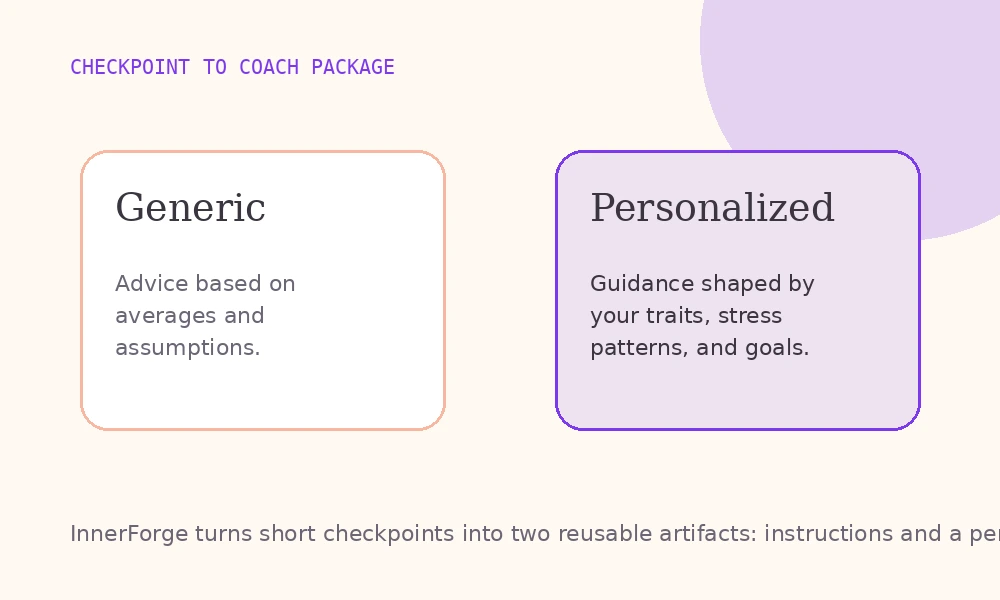
This is where InnerForge diverges from every other personality platform. Most assessment tools give you a report — a document designed for you to read. We give you a free coach package — two artifacts designed for AI to use.
The difference is critical. A human-readable report might say: "You scored high on openness to experience, suggesting you are intellectually curious, imaginative, and drawn to novelty and aesthetic experiences." Interesting to read. Useless for AI personalization.
A coach package translates the same data into structured, actionable context, split across two files:
The coach instructions. A carefully engineered prompt that carries the voice and frame of your chosen coach — but tuned to your specific profile. It tells the AI how to talk to you: directness vs. diplomatic framing, detail vs. high-level, emotional check-ins vs. cut-to-the-chase, when to slow down, what to never do. Different coaches have different default voices; your data adjusts them further.
The personality file. A structured document that sits as a knowledge file / project file the AI reads before every reply. It carries:
- Trait profile. Your Big Five scores with percentile rankings, parseable at a glance by any language model.
- Behavioral patterns. Specific, concrete descriptions of how your trait combination manifests in daily life. "Tends to generate many ideas but struggles to commit. Needs external structure for follow-through. Processes criticism emotionally before logically — allow 24 hours before expecting a rational response." Derived from research literature on your specific profile.
- Communication preferences. How you prefer to receive feedback and advice. Does directness land, or do you need emotional framing first? Detailed plans or high-level principles? Analogies or plain explanations?
- Blind spots and growth edges. What your personality predicts you'll miss or underweight — calibration data for an AI that wants to serve you well, not judgments against you.
- Context-specific insights. How your profile plays out in the domain this coach covers: career, relationships, money, stress, creativity.
Step 5: The paste
Here's the part that makes the whole system practical: your coach package is designed to be pasted into any AI tool you already use. Claude Projects, ChatGPT Projects, Gemini Gems, custom GPTs, AI agents — any system that accepts a system prompt and a knowledge file.
You paste the coach instructions into the project's instructions field. You upload the personality file as a knowledge file. And the AI immediately shifts from generic mode to your mode.
No API integration needed. No platform lock-in. No complicated setup. The artifacts are plain text — portable, universal, and yours to use wherever you want.
This portability is a deliberate design choice. We don't think your personality data should be locked inside any single platform, including ours. Your self-knowledge belongs to you, and it should work everywhere.
Why a coach package beats raw scores
A reasonable question: why not just paste your Big Five scores directly? Why does the coach package layer matter?
Three reasons:
1. AI models think in language, not numbers. A percentile score is a data point. A behavioral description is a prompt. When you tell an AI "user scores 28th percentile on extraversion," it has to infer what that means in practice. When you tell it "user recharges through solitary reflection, prefers written communication over meetings, and delivers their best ideas after processing time rather than in live brainstorming," the AI adapts immediately.
2. Trait interactions require expertise to interpret. High neuroticism plus high conscientiousness produces perfectionism and anxiety about underperforming. High neuroticism plus low conscientiousness produces emotional reactivity without the structured coping that conscientiousness provides — different patterns entirely. These interpretations come from research literature most AI users (and most AI models) don't have at their fingertips. The coach package does the interpretation work upfront.
3. Instructions and data do different jobs. The coach prompt sets the how — voice, tone, boundaries. The personality file sets the who — your scores, patterns, reflections. Separating them is load-bearing: a language model parses a concise, voiced system prompt very differently from a dense data file. We size each for its platform's character limits and target it at its strength.
The psychology behind it
InnerForge isn't built on pop psychology or corporate personality tests. The frameworks we use have specific properties that make them ideal for AI personalization:
Stability. Your Big Five profile is remarkably stable across time and situations. A coach package built from today's data will be relevant six months from now. You don't need to retake checkpoints constantly.
Predictive validity. Big Five scores predict real-world outcomes across dozens of life domains — job performance, relationship satisfaction, health behaviors, academic achievement. This isn't horoscope territory. These are empirically demonstrated relationships.
Universality. The Big Five structure replicates across cultures, languages, and assessment methods. Your coach works regardless of which AI model you're using or what cultural context you're operating in.
Granularity. Continuous scores on five dimensions (plus facets within each) create a high-resolution profile. Two people who both score "high" on conscientiousness can still have meaningfully different profiles when you account for facet-level variation and interactions with other traits.
What changes after you have a coach
The shift is immediate and often surprising. People report that the first conversation with a coach-augmented AI feels qualitatively different — like the AI suddenly "gets" them.
Common reactions:
- "It anticipated exactly what I was going to struggle with."
- "It gave me advice I'd never seen before — but immediately recognized as right for me."
- "It stopped suggesting things that I already know don't work for my personality."
- "For the first time, an AI felt like it was talking to me, not to everyone."
This isn't magic. It's the predictable result of giving a powerful language model the structured context it needs to stop guessing and start personalizing.
A coach doesn't make AI smarter. It makes AI specific. And specific advice you actually follow beats brilliant advice you ignore because it doesn't fit how your mind works.
The bigger picture
InnerForge sits at an intersection that barely existed a few years ago: personality science, psychometric assessment, and AI personalization. As AI agents become more autonomous, the question of whether they truly understand the people they serve becomes critical — and "truly understand" isn't a chat-history problem; it's a structured-context problem.
A coach package is a starting point. It's version one of your AI identity layer — a structured representation of who you are that travels with you across every AI interaction. As you build more coaches, the underlying personality file grows richer. As AI capabilities expand, the package becomes more valuable.
The future of AI isn't just smarter models. It's smarter context. And the smartest context starts with knowing yourself.
Ready to try it? Browse InnerForge's free coaches and pick the one that fits what you're working on. Each one starts with a short checkpoint and ends with a prompt you paste into the AI you already use.
Keep reading
How Personality Data Makes AI Actually Useful
Structured self-knowledge from Big Five, EQ, and values assessments transforms AI from generic to genuinely helpful. See real before-and-after examples.
Paste Your Personality Into ChatGPT, Claude & Gemini
A step-by-step guide to giving ChatGPT, Claude, or Gemini real context about who you are. Two artifacts, a few minutes of setup, same AI you already pay for.
ChatGPT Custom Instructions Template: Copy-Paste (2026)
Copy-paste ChatGPT custom instructions template. Structure personality data and preferences so ChatGPT stops giving generic, unhelpful advice.