
The Future of AI That Knows You
Right now, talking to an AI is like calling a customer service line where nobody remembers your last call. Every conversation starts cold. You re-explain your preferences, re-establish your context, and re-negotiate the tone. The AI is powerful, but it treats you like a stranger every time.
That's about to change — and faster than most people realize.
The next wave of AI isn't about bigger models or better benchmarks. It's about personalization. AI that remembers you, adapts to you, and understands not just what you're asking but who is asking. The infrastructure for this is already being built. The question isn't whether personalized AI is coming — it's who controls the personal data that powers it.
Persistent memory is just the beginning
The major AI platforms are all racing to add memory. ChatGPT remembers facts from previous conversations. Claude is building persistent profiles. Gemini is integrating across your Google ecosystem. On the surface, this looks like personalization.
It's not. Not really.
Remembering that you prefer Python over JavaScript or that you have a dog named Max is useful but shallow. It's the equivalent of a waiter remembering your usual order — nice, but it doesn't mean they understand you.
True personalization requires something deeper: a structured model of your personality, cognitive style, communication preferences, and motivational patterns. Not scattered facts, but a coherent profile that lets the AI adapt its behavior — how it explains things, how it frames advice, how much detail it includes, when it pushes back and when it defers.
The gap between "AI that remembers facts about you" and "AI that understands how you think" is the gap between a contact list and a close friend. Memory is necessary but nowhere near sufficient.
Personality-aware agents
The next frontier isn't chatbots with memory. It's agents — AI systems that take actions on your behalf, make decisions within parameters you set, and interact with other systems autonomously.
Now imagine those agents are personality-blind. An AI agent that books meetings without knowing you're an introvert who needs recovery time between calls. An AI writing assistant that drafts emails in an assertive tone when your natural style is collaborative. An AI learning tutor that dumps information linearly when you're someone who needs the big picture first.
Personality awareness isn't a luxury feature for agents. It's a functional requirement. Without it, AI agents will be technically capable but behaviorally misaligned — doing the right things in the wrong way.
The companies building toward this future are starting to recognize it. But they're mostly trying to infer personality from usage data — tracking how you respond, what you click, how long you spend on things. This is the surveillance approach to personalization: observe the user until you can predict them.
There's a better path.
The self-report advantage
Behavioral inference has limits. Watching someone's clicks tells you what they did, not why. Usage data captures outcomes, not motivations. And it takes enormous amounts of observation to build a profile that a structured assessment can produce in ten minutes.
This is why we believe structured self-knowledge — personality assessments, communication style profiles, cognitive preference mapping — will be the most valuable input to AI personalization. Not because self-report is perfect (it isn't), but because it captures something behavioral data can't: your internal experience.
When you tell a system "I'm high in openness and low in conscientiousness," you're providing a compression of thousands of behavioral data points that would take months of observation to infer. When you specify "I prefer direct feedback over diplomatic hedging," you're giving the AI a clear operating instruction that no amount of click tracking would reliably surface.
This is the idea behind InnerForge's coach packages — two artifacts (coach instructions plus a personality file) rendered from your checkpoint scores. We've written a step-by-step guide on how to use them with today's AI tools — but the real potential extends far beyond manually pasting a system prompt and uploading a knowledge file.
Where this is heading
Here's a sketch of the near-term future, based on trends already in motion:
Portable personality profiles. Instead of every AI platform building its own siloed model of you through observation, you'll carry a standardized personality profile that any system can read. Think of it like an accessibility preference — except for cognitive and communication style. You plug it in once, and every tool adapts.
AI that adjusts in real time. Today's system prompts and project instructions are static. Future systems will dynamically adjust their behavior based on your trait profile and situational context. Stressed about a deadline? The AI shifts from its default exploratory mode to focused, structured support — because it knows your conscientiousness score and your typical stress response.
Personality-aware collaboration. When AI agents work together on your behalf, they'll coordinate not just tasks but tone. Your email-drafting agent will know your communication style. Your scheduling agent will know your energy patterns. Your research agent will know your preferred depth and format. They won't just work for you — they'll work like you.
Cross-platform consistency. Today, you're a different person to every AI you use. In the near future, your personality context will travel with you — from your work tools to your personal assistant to your learning platform. One coherent identity, recognized everywhere.
The privacy question
This future is exciting. It's also dangerous if built wrong.
If personality profiles become the currency of AI personalization, they also become extraordinarily valuable data. Your Big Five scores, communication preferences, motivational drivers, cognitive blind spots — this is the most intimate data imaginable. In the wrong hands, it's a manipulation playbook.
The privacy architecture matters enormously. Key principles that must be non-negotiable:
User ownership. Your personality data belongs to you. Period. Not to the platform that collected it, not to the AI company that processes it. You control what gets shared, with whom, and for how long.
Transparency over inference. Secretly building a personality model from behavioral surveillance is categorically different from helping a user build their own profile through informed self-assessment. The ethical path is the explicit one.
Portability. If your personality profile lives on one platform, you're locked in. True user ownership means you can export your data, move it to a competitor, or delete it entirely.
Granular consent. Maybe you want your learning tutor to know your cognitive style but not your emotional patterns. Maybe your work AI gets your communication preferences but not your neuroticism score. Personalization shouldn't be all-or-nothing.
The companies that win the personalized AI race won't be the ones with the most data. They'll be the ones users trust enough to share their most personal data with. Trust is the real competitive advantage.
Why structured self-knowledge is the currency
Here's the investment thesis in plain language: as AI gets more capable, the bottleneck shifts from model intelligence to model context. The AI already knows how to help you. It just doesn't know you.
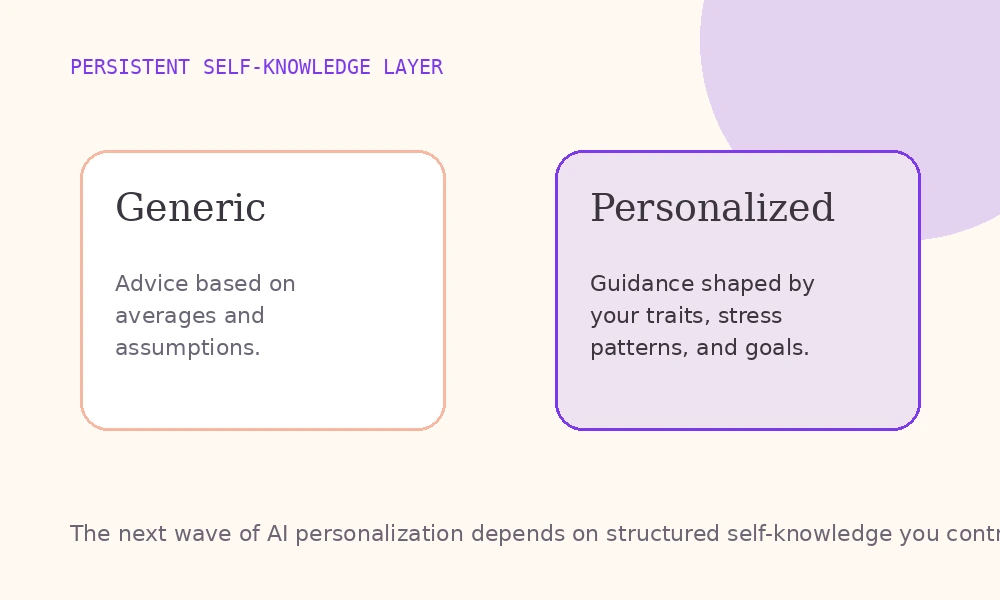
The people who have structured, portable self-knowledge — clear personality profiles, articulated communication preferences, mapped cognitive styles — will get dramatically more value from every AI interaction. Those who don't will continue getting generic, one-size-fits-all responses from increasingly powerful models.
Generic AI
AI will remember more about you over time.
Personality-aware AI
The useful future is not just more memory. It is structured self-knowledge you can inspect, edit, and carry between tools.
The transition is happening now
You don't need to wait for the industry to figure this out. The tools exist today to bridge the gap.
Take a personality assessment grounded in real science — not a zodiac quiz, but something built on validated frameworks like the Big Five. Turn the results into a portable coach package. Paste it into the AI tools you already use. Notice the difference immediately.
As we've argued before, the limitations of AI therapy bots stem largely from personality blindness — they can't adapt to individual differences because they don't know anything about the individual. The same problem applies to every AI interaction, therapeutic or otherwise.
The fix isn't better models. It's better input. And the most powerful input is a clear, structured understanding of who you are.
The future of AI that knows you is being built right now. The question is whether you'll be a passive data point in someone else's model — or an active participant who owns their own self-knowledge and decides exactly how it gets used.
That's the bet we're making at InnerForge. Not on bigger models or shinier chatbots, but on the radical idea that the most important thing missing from AI isn't intelligence. It's you.
Start building your structured self-knowledge today. Browse InnerForge's free coaches — each one starts with a checkpoint and renders a coach package for the AI age.
Keep reading
ChatGPT Custom Instructions Template: Copy-Paste (2026)
Copy-paste ChatGPT custom instructions template. Structure personality data and preferences so ChatGPT stops giving generic, unhelpful advice.
Give Claude a Personality: Custom Instructions Guide (2026)
Set up Claude Projects with custom instructions that make Claude understand you. Personality-based templates for better AI conversations.
Give Gemini a Personality: Gems Setup Guide (2026)
Make Google Gemini actually useful with Gems — custom AI agents that know how you think. Step-by-step setup guide with personality-based instructions.