
Why Your AI Gives Generic Advice (And How to Fix It)
You ask your AI assistant how to be more productive. It tells you to "break tasks into smaller steps," "use the Pomodoro technique," and "eliminate distractions." The same advice it gives literally everyone else.
You ask for help with a difficult conversation at work. It suggests you "use I-statements," "listen actively," and "seek common ground." Perfectly reasonable. Completely unhelpful for your specific situation.
This isn't a bug. It's the fundamental design constraint of every general-purpose AI on the market right now — and understanding why it happens is the first step toward making AI actually useful for you.
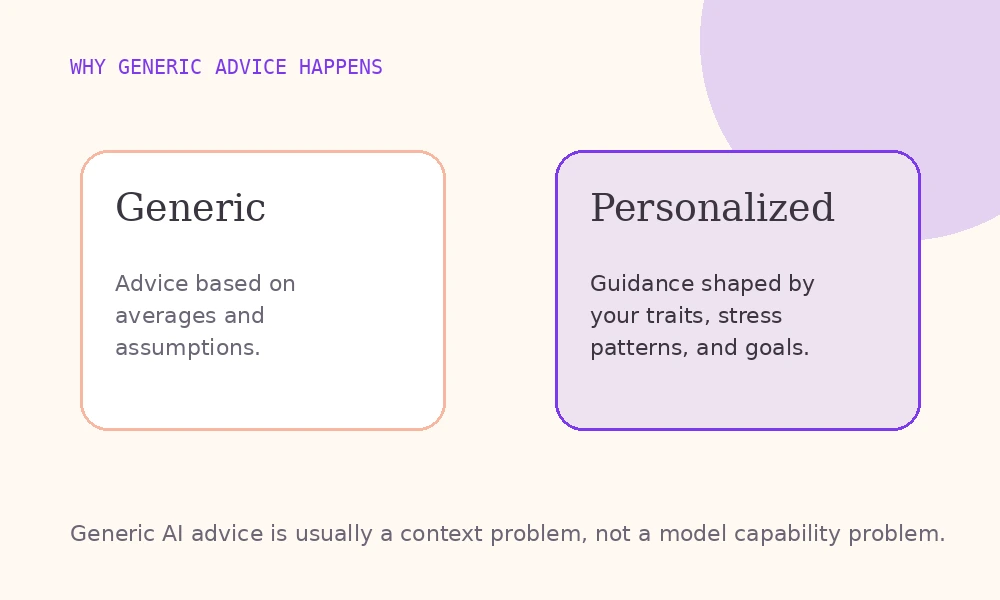
The one-size-fits-all problem
Large language models are trained on vast datasets of human text. They learn patterns of what "good advice" looks like on average. When you ask a question, the model predicts the most statistically likely helpful response given the words in your prompt.
The problem? The most statistically likely response is, by definition, the most generic response. It's optimized for the broadest possible audience, not for you as an individual.
Think of it this way: if a doctor had to give health advice without knowing anything about their patient — no medical history, no symptoms, no lifestyle — they'd default to "eat well, exercise, sleep more." Not wrong. Just useless for someone with a specific condition.
The average answer is only helpful if you're an average person. And no one is average. That's the entire point of individual differences.
How context windows actually work
Every AI conversation happens inside what's called a "context window" — the total amount of text the model can process at once. Modern models have large context windows (some exceeding 100,000 tokens), but they start each conversation essentially blank.
The model doesn't remember your last conversation. It doesn't know your personality, your values, your communication style, your stress triggers, or how you make decisions. Every session, you're a stranger.
Some platforms try to solve this with memory features — storing snippets from past conversations. But this is patchwork at best. Memories are fragmented, unstructured, and often miss the deeper patterns that actually matter.
What's missing isn't more memory. It's structured self-knowledge.
Why "just give it more context" doesn't work
You might think the solution is simple: just write a long system prompt describing yourself. People try this. They write paragraphs about their preferences, their job, their goals.
The problem is threefold:
-
You don't know what matters. Which of the thousands of facts about yourself are actually relevant to how AI should talk to you? Most people over-index on surface-level preferences and miss the cognitive patterns that actually shape how they process advice.
-
Unstructured context is noisy. A wall of text about yourself is hard for AI to parse efficiently. The model has to figure out which parts of your self-description are relevant to each specific question. Structured data outperforms free-form descriptions every time.
-
Self-assessment is biased. We're notoriously bad at describing our own personalities accurately. You might say "I'm very logical" when your actual decision-making pattern is heavily intuition-driven. You need a framework that measures, not just one that asks.
The missing piece: structured personality data
Here's what changes everything: when you give an AI model structured, scientifically validated data about your personality — your Big Five scores, your emotional intelligence profile, your values hierarchy, your cognitive style — the responses shift dramatically.
Instead of "break tasks into smaller steps," a personality-aware AI might tell someone high in openness but low in conscientiousness: "You're going to be tempted to keep exploring new approaches. Pick one and commit to it for 48 hours before evaluating. Your strength is creative problem-solving, but it becomes a trap when you use it to avoid the boring parts of execution."
That's not generic. That's specific, accurate, and actionable — because it's grounded in what we actually know about how that person's mind works.
The difference between personalized and personal
There's an important distinction here. Most AI "personalization" today is really just pattern-matching on your usage history. Netflix recommends movies based on what you've watched. Spotify suggests songs based on what you've played. This is behavioral personalization — it learns what you do.
What's far more powerful is psychological personalization — understanding why you do what you do. Your personality traits predict your behavior across contexts in ways that behavioral data alone cannot.
Someone high in neuroticism doesn't just need different productivity advice — they need advice delivered differently. They need the AI to acknowledge the emotional weight of a task before jumping to solutions. Someone low in agreeableness doesn't need the AI to soften its feedback — they actually prefer directness.
Generic AI
Try making a plan and stay consistent.
Personality-aware AI
Because you lose momentum when plans get too rigid, start with a two-week experiment: one fixed anchor, three flexible blocks, and a review question that checks whether the system still fits your energy.
What this looks like in practice
The AI tools that will win aren't the ones with the largest models or the fastest inference. They're the ones that know their users deeply enough to stop giving average advice to non-average people.
That's the bet we made with InnerForge. Instead of building yet another chat app, we built a marketplace of ten specific AI coaches — each one a carefully engineered prompt plus a structured personality file, both shaped by what we measure from short, science-backed checkpoints. You paste them into the ChatGPT, Claude, or Gemini you already use. If you're comparing that approach with closed companion apps, start with the Pi AI alternative and Character.AI alternative pages.
The result isn't a smarter AI. It's the same AI, with radically better context about who it's talking to.
How to start getting better AI responses today
You don't have to wait for AI platforms to figure this out. The gap between generic and personalized AI advice comes down to the quality of context you provide. Here's what actually moves the needle:
- Know your actual personality traits, not your self-assessed ones. Validated instruments beat self-description every time.
- Structure your self-knowledge. Give AI data it can work with, not paragraphs it has to interpret.
- Be specific about your patterns, not just your preferences. "I procrastinate" is less useful than "I tend to avoid tasks that require sustained focus when I'm emotionally stressed."
The era of generic AI is a temporary one. As personality-aware AI agents become the norm, the gap between people who give their AI good context and people who don't will widen into something that matters.
The question isn't whether AI will get more personal. It's whether you'll bring self-knowledge to the conversation when it does.
Tired of one-size-fits-all AI? Browse InnerForge's free coaches — each one starts with a short, free checkpoint and ends with a prompt you paste into ChatGPT, Claude, or Gemini. Same AI you already use, now with context about who it's talking to.
Keep reading
ChatGPT Custom Instructions Template: Copy-Paste (2026)
Copy-paste ChatGPT custom instructions template. Structure personality data and preferences so ChatGPT stops giving generic, unhelpful advice.
Give Claude a Personality: Custom Instructions Guide (2026)
Set up Claude Projects with custom instructions that make Claude understand you. Personality-based templates for better AI conversations.
Give Gemini a Personality: Gems Setup Guide (2026)
Make Google Gemini actually useful with Gems — custom AI agents that know how you think. Step-by-step setup guide with personality-based instructions.