
Custom AI Agents: What They Actually Are (Beyond the Hype)
Everyone in tech is talking about AI agents. Every product is launching "agent features." Every pitch deck promises autonomous AI that will handle your life. And most of it is hype layered on top of hype.
But underneath the marketing noise, something genuinely important is happening. AI agents represent a real shift in how we interact with artificial intelligence — and understanding what they actually are (and aren't) matters if you want to use them effectively.
Let's cut through it.
What an AI agent actually is
An AI agent is software that can take actions toward a goal, make decisions along the way, and adapt its approach based on what happens. That's it. The key distinction from a regular chatbot is autonomy — an agent doesn't just respond to your latest message. It pursues an objective across multiple steps.
When you ask ChatGPT "what's the weather in Tokyo?", that's a chatbot interaction. Single input, single output. When you tell an AI system "plan a week-long trip to Japan that fits my budget and interests, book the flights, and create a day-by-day itinerary," and it actually does all of that — making decisions, handling contingencies, calling APIs — that's an agent.
The core components of any AI agent are:
- Goal understanding — interpreting what you actually want, not just what you literally said
- Planning — breaking a goal into steps and deciding the order
- Tool use — calling external systems (search, APIs, databases) to take real actions
- Memory — retaining information across steps and sessions
- Judgment — deciding when to proceed, when to ask for clarification, and when to change approach
Why chatbots aren't agents (even when they pretend to be)
Most "AI agents" on the market today are really chatbots with extra steps. They might call a tool or two, but they don't genuinely plan, adapt, or maintain coherent goals over time.
The test is simple: can the system handle a task where the optimal path isn't obvious in advance? Can it recover when something unexpected happens? Does it maintain context about you specifically when making decisions?
A chatbot gives you a recipe when you ask for one. An agent notices that you're trying to eat healthier, remembers you mentioned a nut allergy last week, knows you prefer meals under 30 minutes based on your personality profile showing low patience for routine tasks, and proactively suggests meal prep strategies that fit your actual life.
The difference between a chatbot and a true agent isn't technical sophistication. It's whether the system understands your goals deeply enough to act on your behalf without constant hand-holding.
The memory problem
Here's where most AI agents fall apart: memory. Or rather, the lack of it.
Current AI systems are fundamentally stateless. Each conversation starts from zero unless the platform has implemented some form of persistent memory. And even when they have, that memory is usually a flat list of disconnected facts: "User likes hiking." "User works in marketing." "User is vegetarian."
This kind of memory is better than nothing, but it misses the structure that makes memory useful. Human relationships work because we build models of each other — not just facts, but patterns. You know that your friend tends to overthink decisions, so you give them permission to act. You know your colleague processes criticism slowly, so you give feedback in writing.
AI agents need the same kind of structured understanding to be genuinely useful. Not just what you like, but how you think.
Agent personality: the missing layer
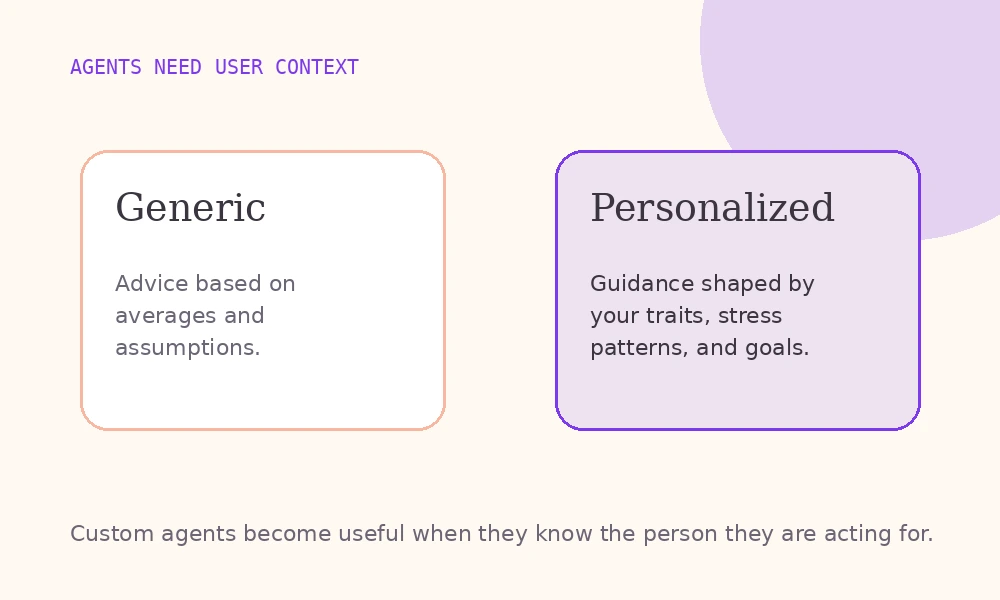
This is the part almost no one is talking about. An AI agent's effectiveness is directly proportional to how well it understands the person it's serving. And the most efficient way to encode that understanding isn't through accumulated conversation snippets — it's through structured personality data.
Consider two people who both ask an agent to help them prepare for a job interview:
Person A scores high in extraversion, low in neuroticism, and high in openness. The optimal agent behavior: focus on structuring their naturally enthusiastic delivery, help them prepare for unexpected questions (their weakness), and keep prep sessions dynamic and varied.
Person B scores low in extraversion, high in neuroticism, and high in conscientiousness. The optimal agent behavior: help them manage pre-interview anxiety, build confidence through thorough preparation, give them permission to pause before answering, and frame the interview as a conversation rather than a performance.
Same task. Radically different approaches. And the agent can only get this right if it has real data about who it's working with.
Custom agents vs. general agents
The industry is splitting into two camps. General agents try to be everything to everyone — your assistant, your researcher, your scheduler, your therapist, your coach. Custom agents are built for specific domains and specific people.
General agents will always struggle with personalization because they're optimized for breadth. They need to handle any request from any person, which pushes them toward the same generic, safe responses we already get from chatbots.
Custom agents, on the other hand, can be opinionated. They can be tuned to your personality, calibrated to your goals, and specialized in the domains you actually care about. A custom writing agent that knows you score high on openness and low on agreeableness will push your writing toward boldness rather than consensus. A custom productivity agent that knows your Big Five profile will suggest systems that actually match your cognitive style.
Generic AI
Create an agent that handles your tasks automatically.
Personality-aware AI
Create an agent that knows your decision rules, tone, constraints, and risk tolerance before it acts. Autonomy without personal context just scales generic behavior.
What makes a "good" AI agent in 2026
If you're evaluating AI agents — or building with them — here's what actually matters:
1. Persistent, structured memory. The agent should build a model of you over time, not just store random facts. Personality frameworks like the Big Five provide the structure that makes memory actionable.
2. Transparent reasoning. You should be able to understand why the agent made a decision. "Because you tend to over-commit when you're excited about a new project" is transparent. A suggestion appearing out of nowhere is not.
3. Adaptive communication style. The agent should adjust not just what it says but how it says it. Some people want direct bullet points. Others need narrative explanations. Your personality traits predict which style actually lands.
4. Appropriate autonomy. Good agents know when to act and when to check in. This calibration should be based on your preferences and trust level, not a one-size-fits-all default.
5. Domain specificity. An agent that does one thing brilliantly beats an agent that does everything adequately. Look for agents tuned to your actual use cases.
The future is personal
The trajectory is clear. AI agents will become more capable, more autonomous, and more deeply embedded in our daily workflows. The ones that succeed won't be the ones with the best base model. They'll be the ones that know their users well enough to act in genuinely personalized ways.
This is why the intersection of personality science and AI matters so much right now. The technology for capable agents exists. What's missing is the self-knowledge layer — structured data about who you are that agents can use to make better decisions on your behalf.
In five years, using an AI agent without a personality profile will feel like using a GPS without entering your destination. Technically functional. Practically useless.
Building that self-knowledge layer is exactly what InnerForge does. We turn validated personality science into structured coach packages — coach instructions and a personality file — that any AI agent can read as system prompt + knowledge, so the agent doesn't have to spend months learning what a five-minute checkpoint can reveal.
The hype around AI agents will fade. The agents that actually understand you won't.
Want your AI agents to actually understand how you think? Start with a specific use case like the Career Coach, Money Coach, or Creative Coach, then give any agent the context it needs to be genuinely useful.
Keep reading
The Future of AI That Knows You
Where personalized AI is heading — persistent memory, personality-aware agents, and why structured self-knowledge is the currency of the AI age.
ChatGPT Custom Instructions Template: Copy-Paste (2026)
Copy-paste ChatGPT custom instructions template. Structure personality data and preferences so ChatGPT stops giving generic, unhelpful advice.
Give Claude a Personality: Custom Instructions Guide (2026)
Set up Claude Projects with custom instructions that make Claude understand you. Personality-based templates for better AI conversations.