
What Your Money Mindset Reveals About You
Here's something financial advisors rarely tell you: the biggest obstacle to financial well-being isn't a lack of knowledge. Most people know they should save more, spend less on things that don't matter, and invest for the long term. The information is everywhere. It's free. And yet the majority of people consistently act against their own financial interests.
The gap between knowing and doing isn't a willpower problem. It's a personality problem. Your relationship with money is shaped by the same psychological forces that shape your relationships, your career decisions, and your stress responses. Understanding your money mindset isn't a financial exercise — it's a self-knowledge exercise.
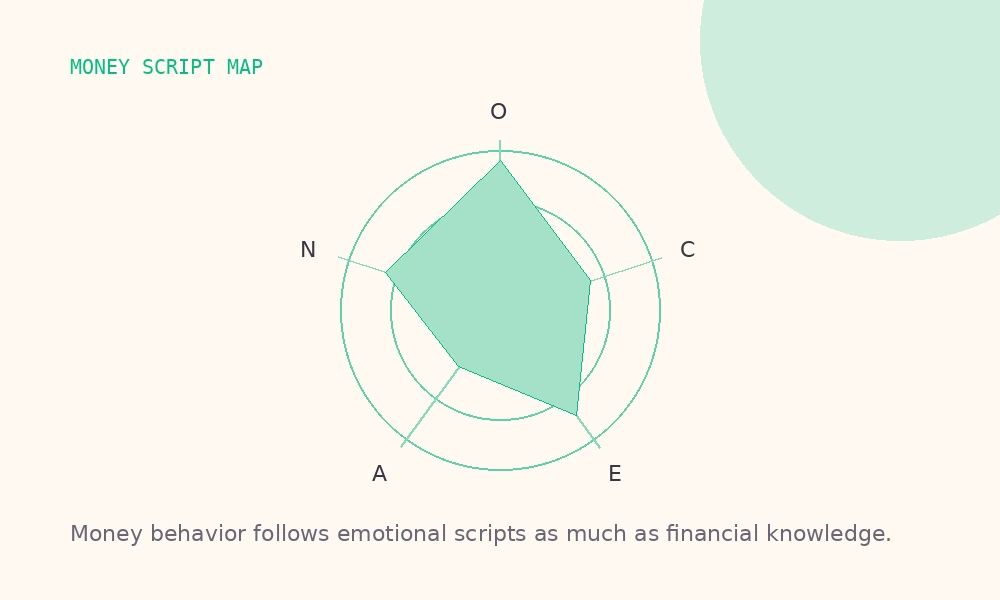
The four financial personality types
Financial psychologists have identified four primary money mindsets. Most people are a blend of two or three, but one tends to dominate.
The Saver (Security-Driven)
Savers find emotional comfort in accumulation. Watching a bank balance grow produces genuine satisfaction. Spending — even on things they want and can afford — triggers anxiety. They tend to be financially stable but may struggle with guilt around enjoyment, difficulty investing (because investment means temporarily reducing their savings balance), and an outsized fear of scarcity that doesn't match their actual financial position.
At the extreme, saving becomes hoarding — not a financial strategy but an emotional coping mechanism for anxiety about the future.
The Spender (Experience-Driven)
Spenders associate money with possibility and connection. They're generous, spontaneous, and oriented toward experiences and relationships. They pick up the check, buy thoughtful gifts, and invest in quality-of-life upgrades without much hesitation.
The upside is that spenders often build rich social networks and extract genuine happiness from their resources. The downside is obvious: without structure, spending can outpace earning, and the present bias that makes spending feel natural makes saving feel like deprivation.
The Avoider (Anxiety-Driven)
Avoiders don't overspend or oversave — they disengage entirely. They don't check their bank balance, don't open financial statements, don't track where their money goes. This isn't laziness. It's anxiety management. Money feels overwhelming, morally complicated, or just unpleasant to think about, so they don't.
The result is financial drift. Avoiders aren't making bad financial decisions — they're not making financial decisions at all. Which, over time, is a bad financial decision.
The Monk (Values-Driven)
Monks believe money is inherently corrupting, or at least that wanting money reveals something negative about your character. They're often drawn to meaningful work regardless of compensation and may feel genuine discomfort with wealth — their own or others'.
This mindset can lead to principled, intentional living. It can also lead to chronic underpaying of self, difficulty negotiating salary, and a pattern of financial self-sabotage rooted in the belief that wanting financial security makes you a bad person.
Your money mindset isn't a choice you made. It's a pattern you absorbed — from your family, your culture, your formative experiences. Understanding it is the first step toward deciding whether it's serving you.
How Big Five traits predict financial behavior
The connection between personality and financial behavior has been studied extensively, and the correlations are strong enough to be practically useful.
Conscientiousness and financial discipline
This is the most robust finding in financial personality research. Conscientiousness — the tendency toward organization, planning, and follow-through — is the single strongest personality predictor of positive financial outcomes. High-conscientiousness individuals save more, carry less debt, plan for retirement earlier, and experience less financial stress.
This makes intuitive sense. The same person who maintains an organized calendar and follows through on commitments applies that same orientation to budgets, savings goals, and financial planning. It's not that they're better with money specifically — they're better at any task requiring sustained, structured effort.
If you score lower in conscientiousness, the implication isn't that you're doomed to financial chaos. It's that you need external systems — automatic transfers, apps that track spending, accountability partners — to compensate for what doesn't come naturally.
Neuroticism and financial anxiety
High neuroticism predicts a complicated relationship with money. On one hand, the heightened threat detection associated with neuroticism can make people more attuned to financial risks — they're less likely to fall for get-rich-quick schemes or take reckless investment risks. On the other hand, the emotional intensity can produce either extreme saving (anxiety-driven hoarding) or extreme avoidance (too anxious to engage with finances at all).
People high in neuroticism also tend to experience more stress around financial decisions, which can lead to decision paralysis or impulsive choices aimed at reducing the discomfort of uncertainty rather than optimizing outcomes.
Agreeableness and financial boundaries
Highly agreeable people are generous — sometimes to their financial detriment. They have difficulty saying no to requests for money, feel guilty about negotiating salary or prices, and may prioritize others' financial needs above their own.
Research shows that agreeableness is negatively correlated with lifetime earnings, particularly in competitive environments. This isn't because agreeable people are less competent. It's because they're less likely to advocate for themselves financially — asking for raises, negotiating deals, or setting boundaries around lending and gifting.
Openness and financial exploration
High openness correlates with interest in alternative financial strategies — cryptocurrency, impact investing, unconventional career paths, entrepreneurship. Open individuals are more willing to experiment with new financial approaches, which can lead to both innovative wealth-building and costly mistakes from chasing novel but unproven opportunities.
Low openness correlates with more traditional, conservative financial behavior. These individuals are more likely to follow established financial advice, which provides stability but may mean missing opportunities that require comfort with the unfamiliar.
Extraversion and financial social dynamics
Extraverts spend more on social activities, dining, entertainment, and experiences — because their reward system is tuned to social engagement, and social engagement costs money. They also tend to be more susceptible to social comparison spending — keeping up with their reference group.
However, extraversion also predicts higher earnings in many fields (particularly sales, leadership, and client-facing roles), which can offset the higher spending — or create a cycle of earning more and spending more that never resolves into actual financial progress.
The emotional roots
Beneath the personality traits and behavioral patterns, money mindsets are fundamentally emotional. Every financial behavior has an emotional payoff:
- Saving feels safe
- Spending feels alive
- Avoiding feels calm (in the short term)
- Minimizing feels pure
The problem isn't the emotion. The problem is when the emotion drives the behavior unconsciously, producing outcomes that conflict with your stated goals. "I want to save more" plus an underlying emotional need for the aliveness that spending provides equals chronic frustration and self-blame.
Rewriting your money story
Financial personality isn't destiny. But changing financial behavior without understanding the personality dynamics underneath is like trying to change the direction of a river by building a dam — the water finds another path.
Effective change follows a sequence:
1. Identify your dominant money mindset. Not what you think it should be — what it actually is. Look at your behavior over the past year, not your intentions. Where does your money actually go? What financial tasks do you avoid? What financial situations trigger emotional reactions?
2. Map it to your personality. How does your Big Five profile show up in your financial behavior? Is your spending driven by extraversion? Is your avoidance driven by neuroticism? Is your under-earning driven by agreeableness? Naming the connection removes the mystery and the shame.
3. Design systems that work with your personality, not against it. A high-openness spender doesn't need the same financial system as a high-conscientiousness saver. The spender might benefit from separate "fun money" accounts that give them spending freedom within boundaries. The avoider might need a financial accountability partner who normalizes engagement with money. The saver might need permission structures that make it emotionally safe to spend on things that genuinely improve their quality of life.
4. Address the emotional root. If saving is driven by anxiety, no amount of financial abundance will feel like enough. If avoidance is driven by shame, no budgeting app will solve the problem. Sometimes the most impactful financial intervention isn't financial at all — it's developing the emotional intelligence to recognize and manage the feelings that drive your money behavior.
Money as a mirror
Your financial behavior is one of the most honest mirrors available to you. It reveals your values (what you actually prioritize, not what you say you prioritize), your fears (what you're protecting against), your relationship patterns (how you use money in social dynamics), and your self-concept (what you believe you deserve).
Most financial advice skips all of this and goes straight to spreadsheets and savings rates. That's why most financial advice doesn't stick. The math is simple. The psychology is where the real work happens.
Understanding your money mindset won't make you rich. But it will stop you from sabotaging yourself in ways you couldn't see before — and that clarity, more than any investment strategy, is what creates lasting financial change.
Take the free money mindset quest — it explores how your psychological profile shapes your financial behavior, giving you insights that go beyond budgets into the patterns actually driving your relationship with money.
Keep reading
From Checkpoint to Coach: How Psychology Becomes AI Context
How InnerForge works end-to-end — pick a coach, take a checkpoint, paste the prompt into ChatGPT, Claude, or Gemini. Psychology meets AI.
Decision-Making Styles: Are You a Thinker or a Feeler?
Thinker or feeler? Neither is better. How the thinking-feeling spectrum shapes your career, relationships, and daily decisions — and how to flex.
How Personality Data Makes AI Actually Useful
Structured self-knowledge from Big Five, EQ, and values assessments transforms AI from generic to genuinely helpful. See real before-and-after examples.